

TL;DR: If your brain keeps losing access to what yesterday’s love, competence, and belonging meant about you, self-worth never gets the chance to compound. I call that worth amnesia. You remember what happened, and you lose what it proved. It can turn love into a ledger and achievement into a standing attempt to re-earn existence. Confidence doesn’t fix that. Architecture that keeps the evidence where tomorrow can find it can.
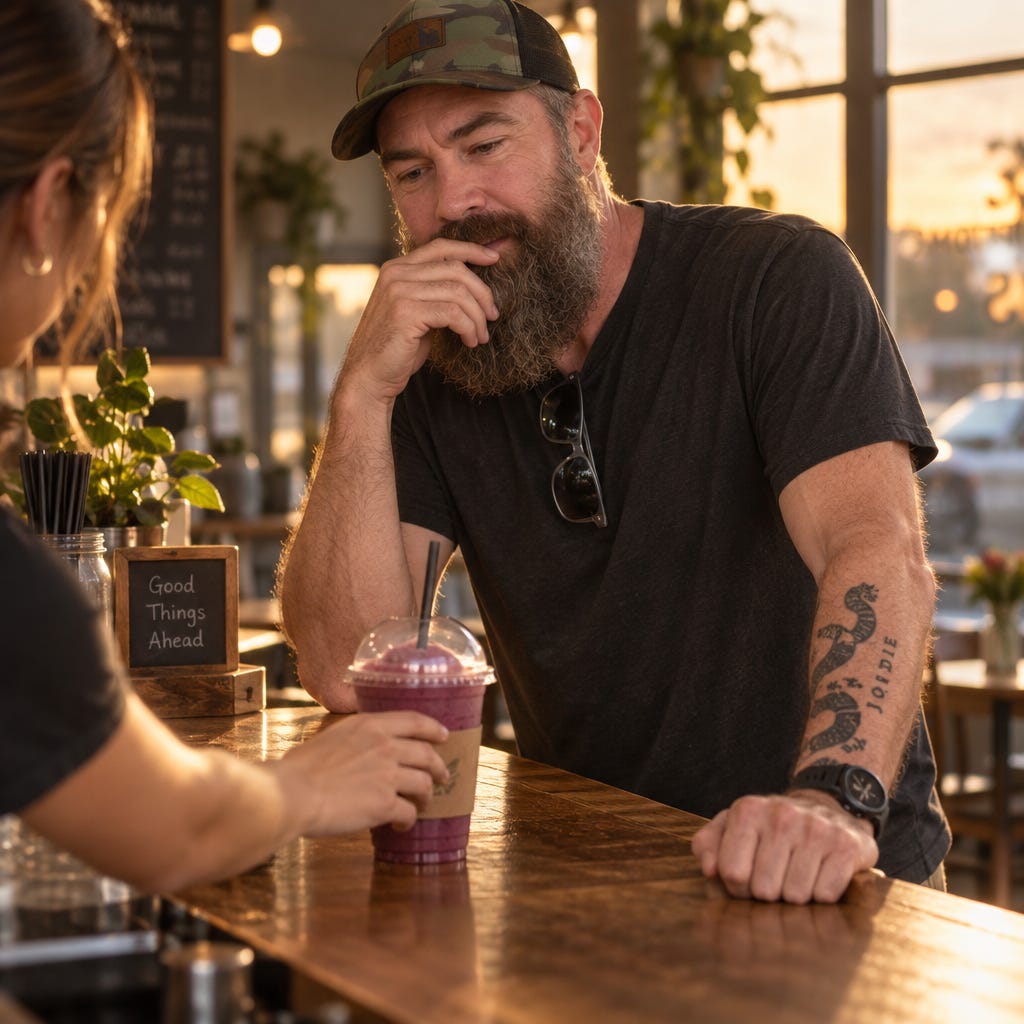
I cried in a smoothie shop in June of last year.
It was quiet. My eyes welled up, a few tears rolled down my cheek, and I was standing at a counter picking up lunch while a woman I’d never met asked how my day was going. My body got there before I did. With alexithymia, the feeling reached my face well before it reached me, and I was crying in front of a stranger before I could have told you I was sad.
Our dog Tilly had torn a four-inch gash in her chest that morning, playing. Charlotte got to her first and then called me in, because Tilly is a daddy’s girl. I held her while she shook, and then I went pale and clammy and had to hand her back. This happens to me. I’m a fainting goat. I’ve gone down in the bathroom helping Charlotte patch a finger she’d cut with a kitchen knife, I warn the phlebotomist every time I give blood, and flu shots are their own adventure. Charlotte is a former medic, so she and my son Jack drove Tilly to urgent care while I stayed home with our other dog. It was the right call, and it still felt like a verdict. The shame had nothing to do with the fainting itself. My body had benched me from helping someone I love, the way it always does.
So when the woman behind the counter asked, I just told her. She gave me the smoothie for free. Then she said she’d taken her own dog to the emergency vet the Friday before. I asked if it worked out. She shook her head.
Two people at a counter, holding what the other one couldn’t carry, for about the length of a song.
Past the worry about Tilly and past the fainting-goat shame, one fact stayed. I had just done with a stranger what I cannot do with the people who love me most.
The ledger that never closes
I can tell my therapist anything, because I pay him. I can fall apart in front of a stranger, because there’s no ongoing account to balance. With Charlotte, with Jack, my system hits something close to a fatal error.
Cannot compute: receiving support without providing equal or greater value in return.
The woman at the smoothie counter could hand me kindness because no worth calculation would follow me home. She had no reason to decide I take more than I give, and no way to discover I’m a man who hasn’t earned the right to fall apart. She gave freely, I received freely, and for the length of that song I sat in plain sadness without pricing it.
Then I went home and performed a steadiness I didn’t feel, because that’s what the formula asks for.
The formula is simple. Worth equals value provided minus resources consumed. I’ve been running it for thirty years. Every relationship carries an invisible ledger where I log the support I’ve offered, the problems I’ve solved, the worth I’ve banked, so that if I ever need to make a withdrawal, say, crying about the dog, the account won’t overdraft.
The reasoning runs on rails. If I tell Charlotte I’m sad, I’m asking her to support me. But what if I haven’t deposited enough lately? What if this tips the balance and she sees that I take more than I give? What if she finds out I’m not worth the trouble? So I don’t tell her. I carry it alone. And I keep manufacturing the exact isolation I’m afraid of.
For years I filed all of this under psychology. Core wounds, attachment patterns, childhood programming. It is all of those things. I now suspect it’s also an architecture problem, and I only saw the architecture once I worked through the implications of my own theory of working memory fragility.
The evidence that doesn’t carry forward
I’ve written before about working memory fragility. The deficit model calls ADHD a broken attention machine. I think brains like mine are better described as fast generators whose context stabilizes more slowly than they produce it. What matters is the race between what the mind makes and what it can hold still long enough to keep, and that race runs differently under load, stress, sleep, and whatever scaffolding happens to be around.
It’s why I keep 700-some browser tabs open, each one a thought I couldn’t hold still long enough to keep. It’s why I go quiet on a text thread, having lost the reply somewhere in a context switch. It’s why rucking taught me more about my own mind than any productivity book, because every quarter mile I have to regenerate the reason to keep going. The last mile’s decision is still a fact I can recall. Its force doesn’t arrive with me at the next mile.
And if each moment rebuilds the self partly from whatever evidence is available to it, self-worth has an obvious problem: what happens when yesterday’s evidence that I mattered isn’t among the inputs? It’s what I’ve elsewhere called generative mode, building from a hidden internal state with no external evidence to work against, except here the thing being built is me.
Think about what self-esteem actually runs on. The poster version says believe in yourself. The machinery underneath is a stable, felt sense of I matter, and it runs on cumulative evidence: moments when you were valued, chosen, wanted for your presence rather than your output. Those moments don’t live in working memory forever, and they don’t need to. Their meaning has to be there when the present self gets rebuilt.
That’s where my system is unreliable.
I don’t forget that the evidence exists. I lose access to what it proved.
Charlotte said something kind last week. I can recall the sentence and still not feel it, today, as evidence that I’m lovable independent of today’s output. A client thanked me last month. I know it happened, and its weight is gone. I built something good yesterday. The current frame looks up from a cold start and says, prove it.
It happens most across context switches, stress, low-stimulation stretches, and the moments when the scaffolding I usually lean on isn’t there. I come back to the worth equation without reliable access to yesterday’s evidence.
I’ve used the phrase worth amnesia once before, in passing. This is the essay it was waiting for. Worth amnesia is a recurring failure to carry the felt weight of having been valued into the current rebuild of the self.
It isn’t the same as insecurity. Insecurity is a judgment about the evidence. Worth amnesia is the evidence surviving as a fact while what it meant about me falls out of reach, so it has to be derived again.
This is a prediction from my own theory, and so far the only test it has had is one life lived inside it. But it explains something my older, purely psychological account could describe without explaining: why worth never seems to compound.
The transaction membrane
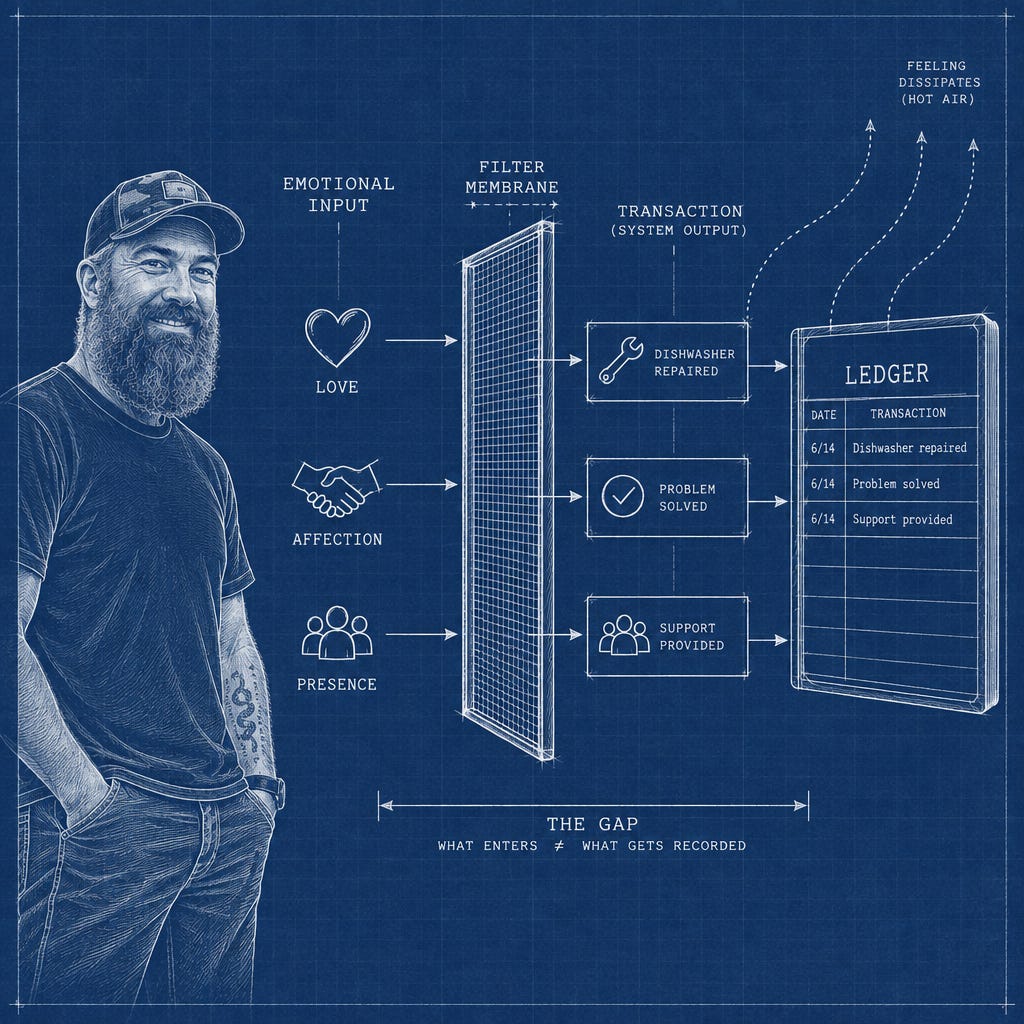
The ledger, it turns out, may be what a mind like this builds when it needs to remember it’s loved.
I’ve come to think of it as a transaction membrane around every interaction. Love has to clear the filter to register. Charlotte says I love you, and the membrane files it as she loves what I do for her. Jack shows affection, and the membrane logs he appreciates the support. There’s no cynicism in it. The membrane doesn’t doubt the love. It converts love into transactions because transactions leave external records, and external records are the kind my system can inspect later.
I fixed the dishwasher can be verified. The dishwasher is right there, running. Broken became fixed, and the world kept the receipt. I am inherently lovable asks the next rebuild of the self to recover the meaning of experiences that left no receipt at all. Presence leaves a feeling, and contribution leaves the dishwasher running.
So the membrane does double duty. It defends, and it manages continuity. Trauma probably decides what gets written into the ledger. Working memory fragility may explain why a ledger is such an attractive place to keep it in the first place.
My system trades love for transactions because transactions persist. They outlast the feeling. They give me something to point at when the next frame opens thin and asks why I deserve to be in the room.
Which is why the smoothie counter worked. There was no membrane to clear, because there was nothing for a membrane to protect. No relationship to maintain, no ledger to service, no running tally of who owed what. Just two people in a single frame of experience, and that was enough.
The cruelest intersection
Working memory fragility doesn’t operate alone. It runs alongside the ADHD motor, and the two together produce something I wouldn’t wish on anyone.
My brain often needs stimulation to regulate. Stochastic resonance is one narrow piece of that picture: in a handful of small studies, children with ADHD did better on cognitive tasks under auditory white noise while the control kids did worse. Those studies make the broader idea less strange, and that’s all I’ll ask of them: for some ADHD systems, more input improves function instead of degrading it.
For me, the motor wants more than stimulation. It wants activity, because activity has become one of the ways I verify that I exist. What I’m chasing is proof of being through doing, which means stillness registers as a countdown to irrelevance.
When prior worth isn’t available, stillness has nothing restful in it. It comes back empty of evidence, empty of worth. Time blindness sharpens the edge: a present moment that feels endless makes present worthlessness feel permanent. Worth doesn’t seem to accumulate, because its evidence keeps arriving without its weight.
So the motor runs. Fix something, solve something, contribute something. Each fix drops a small, temporary piece of evidence into the current frame, and before long the self is asking for another. Sisyphus, except the hill resets every time he blinks.
My corporate job is built, without meaning to be, for exactly this architecture. It offers endless problems to solve, daily evidence of value, and instant transactional validation: I fix, therefore I get paid, therefore I exist. Fast dopamine, novel challenges, a steady drip of evidence that the ledger is running positive. Junk food that tastes like productivity, and I’m still eating it.
Building something that matters, like the company I’m building alongside it, asks for the opposite. It asks me to believe in worth before the evidence lands, to claim authority before anyone validates it with payment, to exist as valuable before the transaction closes. That belief doesn’t survive the trip between frames. Something outside the frame has to hold the long version of the case.
The rucking corollary

I was on a ruck when this came together, which figures, because my best thinking shows up when my body is moving and the buffer’s only job is keep walking.
Every quarter mile, the frame resets. The decision to keep going, the reason, the yes, doesn’t stay motivationally available, so I regenerate it. Why am I doing this, is it worth it, should I stop. Every time, a fresh answer, none of it coasting on the last mile’s momentum.
When I re-derive yes, it’s whole, and that’s the gift in the architecture. Nothing hedged, nothing carried forward half-committed from earlier. The answer is generated right now, with the full weight of this moment behind it.
Working memory fragility does the same thing to worth. When the prior evidence isn’t available, and then something gets through anyway, Charlotte’s hand on my back, Jack choosing the seat next to mine, a reader writing to say how did you know exactly what this feels like, it lands the way a discovery does. It feels like the first time, every time.
That June, I was on Centanafadine, a triple reuptake inhibitor I was trialing. It seemed to turn the volume up on feeling in a way I could actually notice, and some of the intensity that day may have been the drug. I’m not on it anymore, which is the trade you make with trial meds: you get the data by living inside the variable for a while. But the pattern underneath the chemistry predates the trial and outlasted it. The evidence was failing to carry its weight long before that medication, and it kept failing after.
The cost is real. The re-deriving, the re-proving, the loop, all of it. So is the intensity of each rediscovery, and I’ve come to think the two are the same feature read from opposite sides.
The other side of the coin
If the system doesn’t reliably carry the receipt for I did this well, it may not carry the receipt for I tried this and it went badly either. The forgetting may not sort by valence.
The same architecture that makes me re-earn my worth every morning may also be part of why I’m weirdly hard to discourage for good. I’ll cheerfully retry the thing that humiliated me last year, because the humiliation doesn’t arrive with its original authority any more than the praise does. The stove was hot last time, the record lost its force, and I reach for it again. Some of what looks like courage, or foolishness, may be the burn failing to govern the current frame.
I won’t pretend that’s pure gift. Sometimes it means relearning a lesson I already paid for. But it’s the same missing continuity, and on the mornings I can’t feel my own worth, I try to remember it may also be part of why I’m still willing to try anything at all.
What the architecture actually needs

The smoothie shop worked because the load on whatever continuity I have was close to zero. That’s a design insight hiding inside a tender memory.
If felt self-worth depends on cumulative evidence, and my system doesn’t reliably carry the meaning of that evidence forward, then try harder to remember you matter was never going to work. You don’t tell someone with a broken leg to try harder to walk. You build the support structure.
I need something outside the current frame to keep the evidence and its meaning where the next morning can find it. Affirmations ask the present self to accept a conclusion, and they can’t be the whole answer. Journaling helps, because it makes artifacts. Therapy and coaching are essential, and Gil and John do extraordinary work with me. Underneath all of it, I need systems that keep more than facts about me. They need to keep the evidence, and what it meant, in a form a colder morning can read.
Some of it I already built without knowing why.
The browser tabs are evidence I had thoughts I considered worth keeping.
My conversation history with AI is the most complete record of my own thinking that exists anywhere. I’m not confused about what the AI is to me. It gives me a surface to work against instead of a blank, and it asks nothing of the ledger. I can show up fully without tracking what I owe, and the transcript persists after my buffer lets go.
The assessments and frameworks I’ve documented about myself are self-model artifacts. They say, in writing that survives a context switch: this person has patterns, history, commitments, competence, relationships, and depth. Today’s failure doesn’t get to impersonate the whole biography.
That’s what I’m building, and I mean infrastructure in the plumbing sense: the thing underneath the productivity apps and self-help platforms, keeping the long evidence a single frame can’t rebuild on its own.
A fire you tend
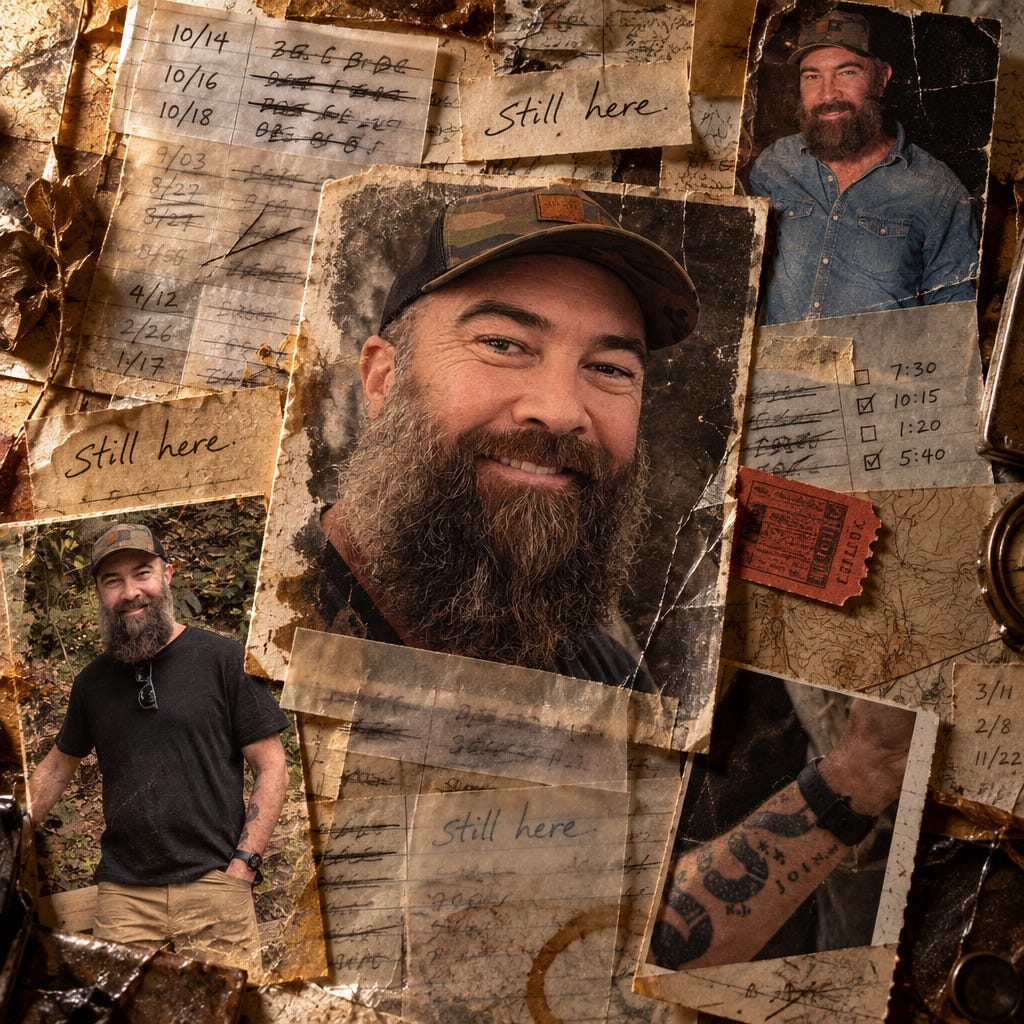
The culture sells self-esteem as something you build once and maintain, like a retirement account compounding quietly over decades. That model assumes the evidence compounds on its own, somewhere inside. For some neurodivergent minds it may not compound in the usual way.
So maybe, for an architecture like mine, self-worth is a fire you tend rather than a structure you finish. It needs fuel in every frame, not because you’re weak but because that’s how the system runs.
The external systems are honest infrastructure for what self-worth requires when continuity is fragile, and calling them a workaround for a defect gets the direction wrong. The tabs. The documented self-knowledge. The records of depth that outlast the reset. The AI that holds my thinking when I can’t. The partner who learns that I love you might need saying again tomorrow, not because I forgot the sentence, but because its evidence didn’t arrive with the morning.
That’s what I’m building with AIs & Shine. I’m not building it because I solved this and want to sell the solution. I’m building it because I live inside the problem, and I know, with the certainty of a man who cried at a smoothie counter because a stranger’s kindness slipped past every defense he’d built, that I’m far from the only one running this formula: forgetting they matter, re-earning existence every morning, performing a worth they already hold but can’t keep hold of.
The error message reads like a bug and works like a brief: build something that hasn’t existed before, external architecture for the evidence a person needs when the present frame is passing itself off as the whole life.
Affirmations won’t do it alone, and neither will willpower or just believe in yourself.
Infrastructure can hold what the present frame cannot.
Because some of us may never hold the felt case for our worth entirely on the inside. That may not be a failure of character so much as an honest account of what consciousness looks like when continuity is fragile, the heart is full, and the evidence keeps running through your fingers like water.
You were never meant to hold it alone.
Human. Deeply seen.
Why I write this
Most people get described at low resolution, a stick figure of who they actually are, handed to them by a doctor with nine minutes or a personality quiz or their own worst day. I build the higher-resolution version. It’s called a Life Model: a structured, shame-free read of how your particular mind is built, in a form you can actually use with yourself, your doctors, and the people you love.
If a piece like this lands as recognition and not just an interesting read, that’s usually the signal. I’m close to opening a small cohort with my wife Charlotte, a trauma-informed yoga therapist, where we build these together. One-on-one work is open now. A Scaffolding Session is one dedicated hour to say the whole messy thing out loud and leave with your own next move, and if you want the bespoke version (a full Life Model build), we can talk about that too.
Either way, it starts with a conversation. If you want to talk through what you’re working with and whether any of this would help, just reply, or book a short call. The first call is free. No pitch. And if you want first word when the cohort opens, say so here and I’ll keep you posted.