


A companion to Somebody Should Be Writing This Down.
TL;DR: AAC (Augmentative and Alternative Communication) is the field that gives people alternative channels when speech is unreliable. I’ve spent three years building AAC for identity: alternative channels for when working memory can’t reliably hold and communicate who I am. I didn’t know the framework existed until someone said the acronym in the right context; I’d already built four layers of it. And the fight that won AAC its legitimacy is suddenly current again, because platforms have started scanning the output of people’s writing aids.
For most of my life, the only AAC I knew about was the audio format I wanted my Napster files encoded in circa 2001. Advanced Audio Coding. Better compression than MP3. I was very passionate about this at nineteen, which tells you something about my brain that a personality assessment would take forty minutes to uncover.
Then, this spring, someone mentioned AAC in a neurodivergent context, and I recognized something I’d already spent three years building. It was like finding out the thing you’ve been constructing in your garage has a name, a field of study, and a decades-long advocacy movement behind it.
The thing I built is a communication device. I just didn’t know that’s what it was.
What AAC actually is
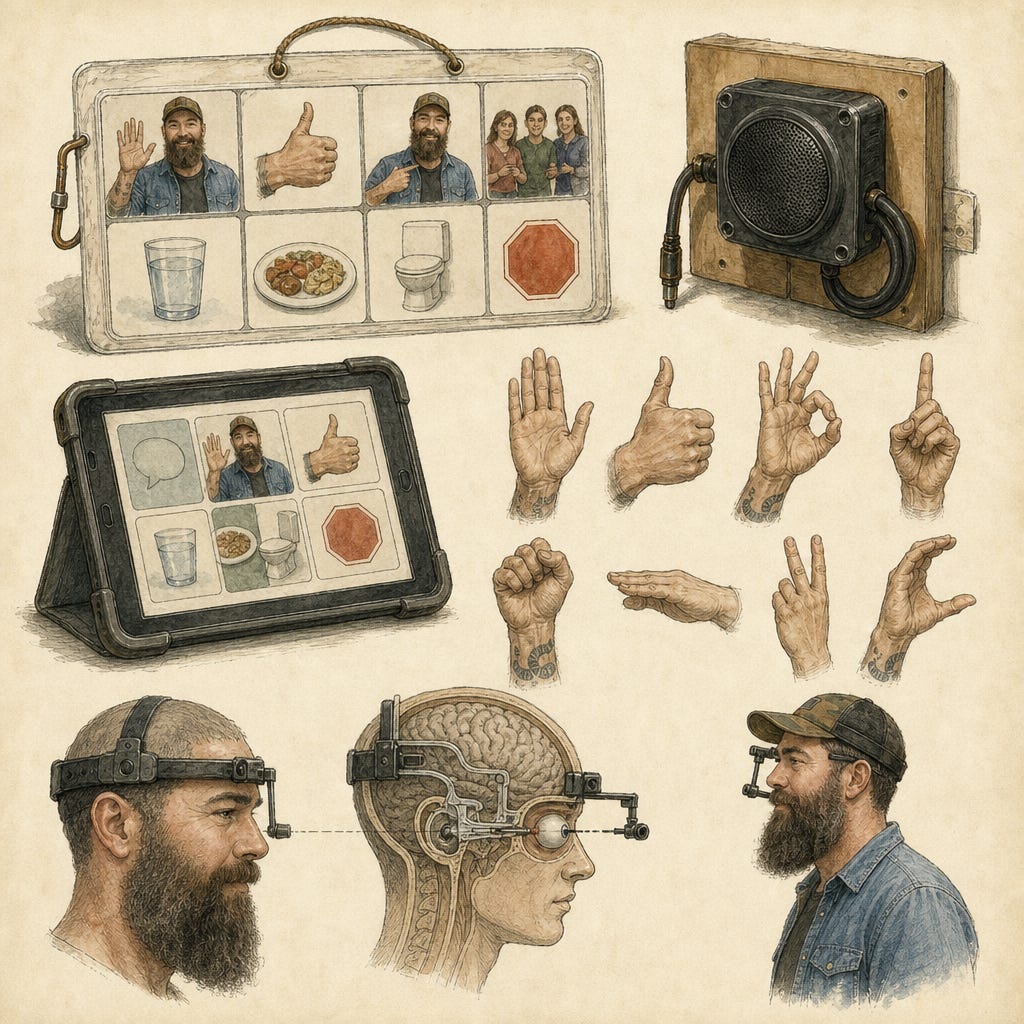
Augmentative and Alternative Communication is the field of tools and strategies that help people communicate when spoken language is unreliable, absent, or insufficient. The range is enormous: picture exchange systems for children, speech-generating devices mounted on wheelchairs, text-to-speech apps on tablets, sign language, eye-tracking interfaces that let someone select words by looking at them.
The tools vary. The principle underneath them does not.
Communication is a human right. If your primary channel doesn’t work reliably, you deserve an alternative one, a valid channel rather than a consolation prize that marks you as deficient.
The neurodivergent and disability communities fought for decades to establish this. The fight was real, and it mattered. Before AAC advocacy, people who couldn’t produce reliable speech were often assumed to have nothing to say. The tools proved otherwise. Give someone an alternative channel and it turns out they had thoughts, preferences, humor, complaints, and complex inner lives the whole time. The bottleneck was the channel.
I want to be careful here, because I’m about to extend this framework into territory its originators didn’t design it for, and borrowing a framework is not a neutral act. What I’m claiming is structural similarity in the underlying problem, not equivalence between my experience and the experience of someone who needs a speech-generating device to order coffee. That structural similarity is what matters. But a claim like that comes with obligations. The term keeps its history attached: every time I write AAC in this piece, I mean the field that real advocates built for people the world had decided were empty, and the debt runs in one direction, from my extension back to their fight. The word stays a field. I answer to the people who built it. And the test I’ll hold this piece to is simple: if someone who orders coffee through a device reads this and feels their fight was borrowed as a metaphor, I’ve failed, because the principle they won was bigger than speech on purpose. Communication is a human right. The sentence never specified the channel, and it never specified which part of a person was doing the communicating.
The layer nobody extended
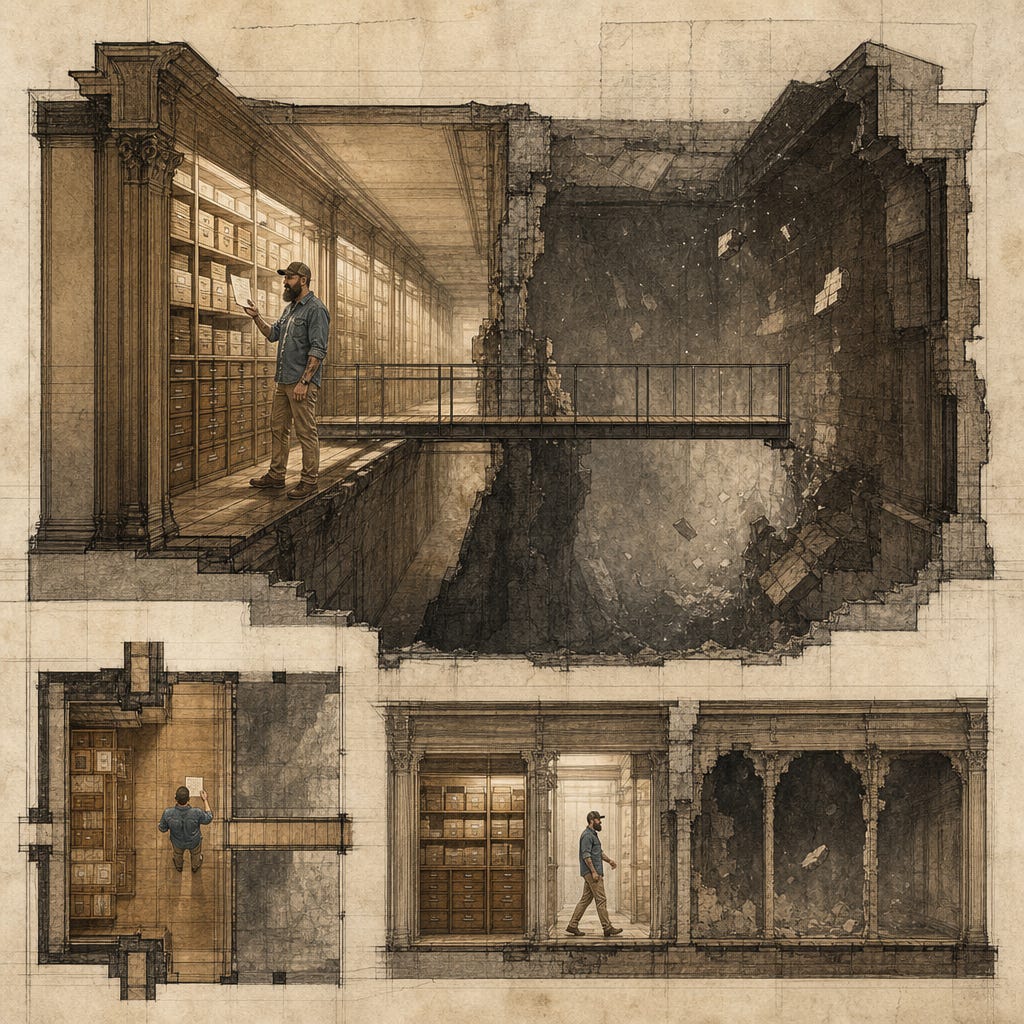
AAC solves a specific communication gap: the distance between having something to say and being able to say it out loud.
There is another communication gap that nobody has built tools for. The distance between knowing who you are and being able to express it.
For most people, this gap is invisible. You know your name, your preferences, your values, your history. You can tell someone what matters to you, what triggers you, how your mind works, what you need in a relationship. The knowledge is there and the retrieval is reliable. Identity is a channel that just works.
For someone with working memory fragility, it doesn’t.
I know who I am. I have spent three years in therapy, coaching, neurofeedback, genetic testing, brain scanning, and AI-assisted self-discovery accumulating the most comprehensive self-knowledge of anyone I’ve ever met. I have the data and the frameworks: fifty-two structured Life Model tables, inside a database that has grown past one hundred eighty, capturing my psychometrics, my cognitive architecture, my energy patterns, my attachment dynamics, my triggers, my decision-making frameworks, and my relational maps.
And some mornings, I wake up and can’t reliably access any of it.
I've written about this before. I just didn't have a name for it. I call it the Groundhog Day Loop. I lose track of where I was with something. Yesterday’s progress doesn’t reliably carry into today, because it was never durably cached to begin with. Some days I can articulate my entire theoretical framework with a precision that surprises even me. Other days I reach for the explanation and get Error 404. The knowledge is there. The retrieval path is gone.
Lee Hopkins, a psychologist and fellow AuDHD late-identifier, wrote about my system and landed on the phrase that ties this whole thing together. He described what I’d built as scaffolding for “a self that does not trust its own continuity.”
That’s the identity equivalent of unreliable speech. And it needs AAC.
AAC for self-knowledge
In seventh grade, I walked up to my school librarian and asked for a book on discipline.
I wrote about that moment in “What My Brain Scan Taught Me About Enlightenment.” Standing there at twelve years old, knowing something wasn’t working the way it worked for other people, unable to name what it was. Brilliant insights I couldn’t reconstruct by morning. A brain that moved at 200 miles per hour with no way to downshift. The feeling: I know something’s wrong, and I don’t have the vocabulary to explain it.
That kid needed AAC for a channel nobody thinks of as a channel: self-understanding.
He had an internal experience (consciousness dropping threads, the narrator losing the plot, executive function collapsing without warning) and no channel to communicate it, not even inward to himself. He couldn’t describe what his nervous system was doing because no one had ever given him the vocabulary, the diagnostic framework, or the mirror.
He spent thirty years trying to solve a problem he couldn’t name. He bought books on productivity and tried every system he could find. The tools available assumed the primary channel was working. It wasn’t.
The AAC devices that finally worked for self-knowledge didn’t look like communication devices. They looked like data.
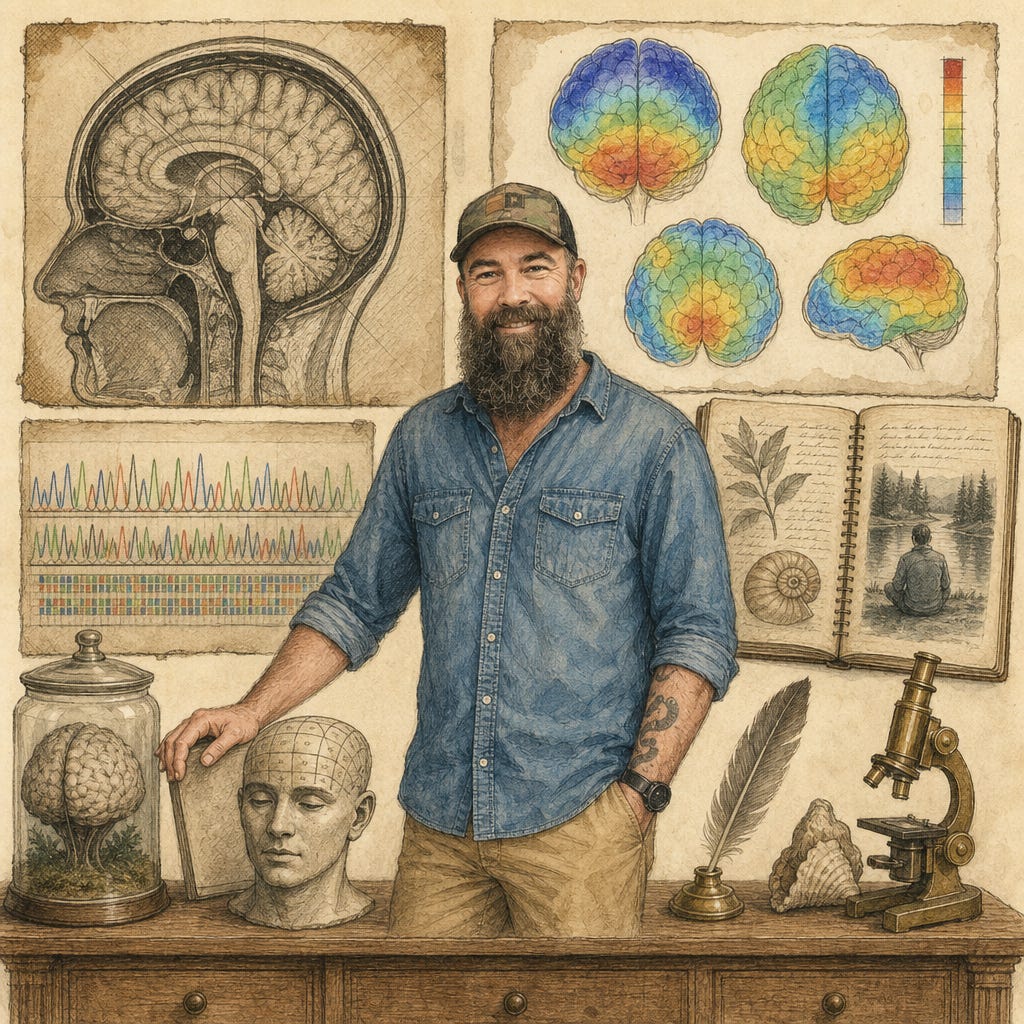
A research-grade MRI through UT Austin. Seven analysis pipelines on volBrain. A QEEG brain mapping session with my neurofeedback practitioner, Gil. My whole genome sequenced at 30x depth. These gave me a language for what my nervous system had been doing for four decades. Right cerebellar asymmetry explaining the compensation patterns. 85% hyper-connectivity explaining why I can’t downshift. Normal prefrontal cortex explaining why the “broken executive function” narrative never fit.
My 700 browser tabs stopped being a sign of disorder and became what they actually were: external working memory. Each open tab is context I don’t have to hold internally. Each documented conversation is identity I don’t have to reconstruct from scratch.
For a mind built this way, external working memory is a valid communication channel, and the field that studies valid alternative channels already has a name.
AAC for availability
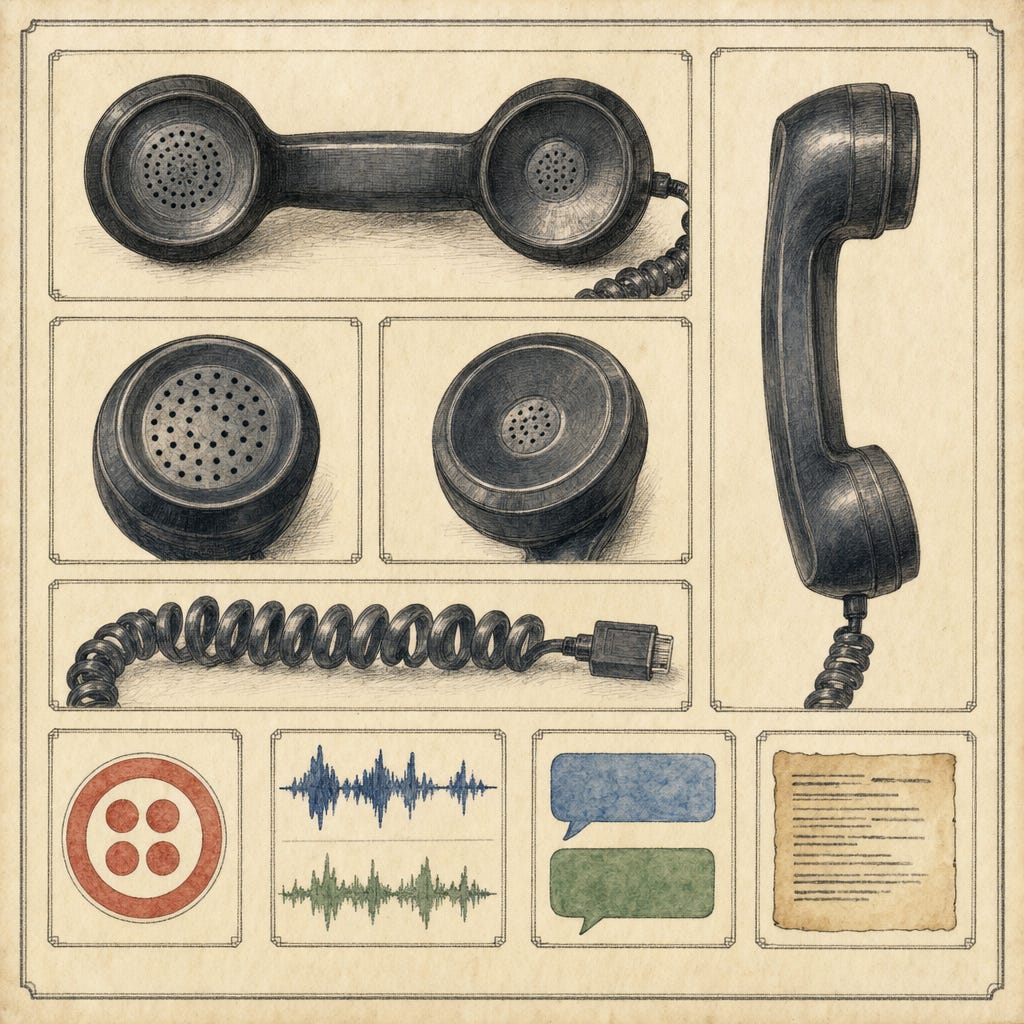
I built a phone number you can call and have a conversation with my external mind.
The system works like this: you dial the number, Twilio routes the call to a voice AI pipeline, your speech gets transcribed, the text goes to Claude with a 54KB system prompt containing my complete cognitive context, and Claude’s response gets spoken back in a voice cloned from a short, lower-quality recording of my actual speech. I skipped the sixty minutes of varied speech patterns a rented studio session at Guitar Center would have gotten me. I think I like it a little imperfect. Nobody mistakes the voice on the phone for actually being me. The AI has access to my writing, my brain data, my genetics, my supplement protocols, my neurofeedback progress, and my entire Substack catalog, most of which sits behind a login. The phone agent is one of the few doors into it that doesn’t need an account.
When I built this system, I framed it in three layers: jonmick.ai as my externalized memory, my Substack as my externalized voice, the phone agent as my externalized availability.
I didn’t realize it at the time, but those three functions map directly to what a speech-generating device does.
A speech-generating device stores vocabulary. It produces speech. And it’s always ready when the person needs it. No bad days, no lost retrieval path, no waking up having forgotten what it knows.
My phone agent is an AAC device for identity. People call it and ask about my brain scan data, my working memory fragility framework, my supplement stack, my theoretical arguments. The system answers with more consistency than I can on a tired Tuesday, because the system doesn’t have a Groundhog Day Loop. The knowledge is always there and the retrieval path is always there. That’s the whole point.
I built this system because people kept wanting to understand what I was building and I couldn’t always explain it. I don’t always know where I left off. Some days the explanation lands with startling clarity. Other days I reach for it and it’s gone. So I built a device that communicates who I am when my primary channel (my own voice, my own memory, my own on-the-spot articulation) is unreliable.
That is, almost word for word, the definition of augmentative and alternative communication.
AAC for relationship
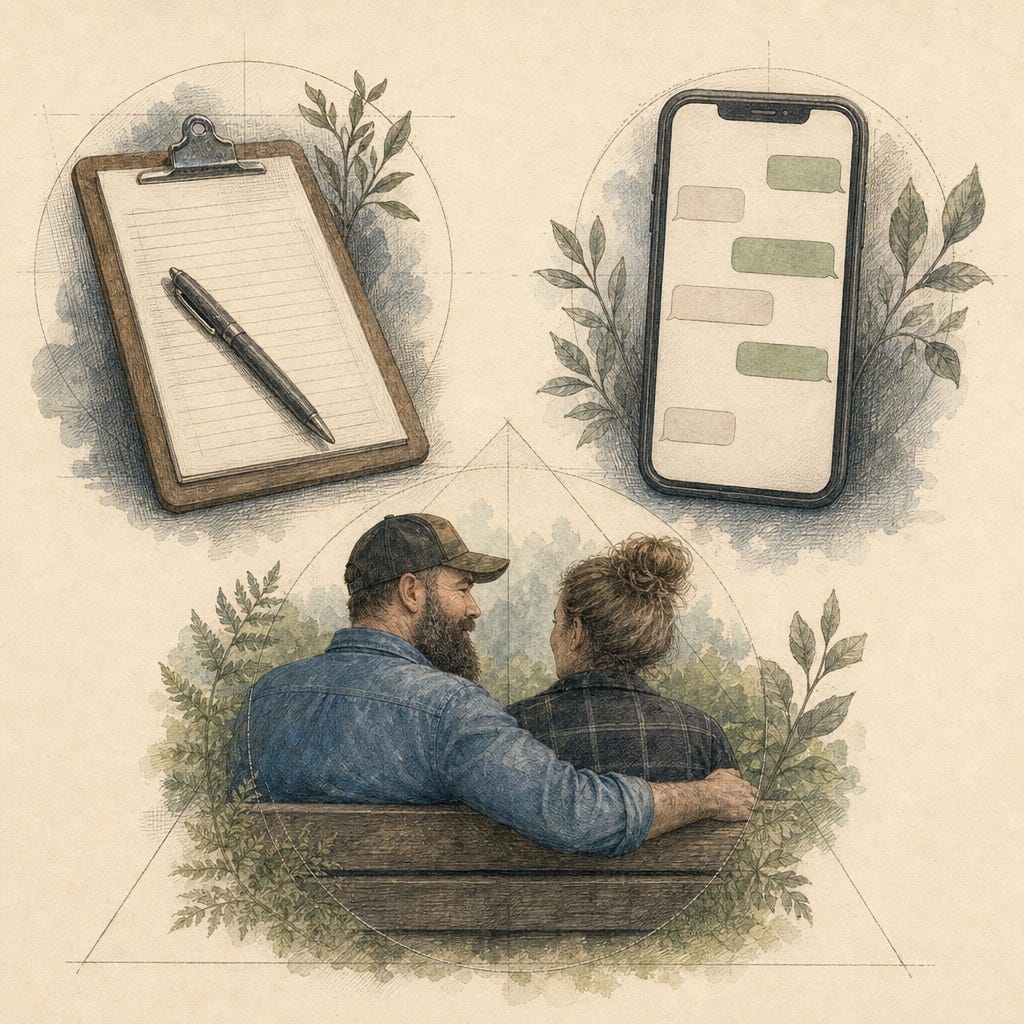
The relationship layer extends the framework beyond anything traditional AAC was designed for.
A speech-generating device helps a person express themselves to someone else. “I want water.” “I’m in pain.” “That was funny.” The communication flows in one direction: from internal experience to external expression.
The Perspective Translator I built for my marriage does something more complex. It translates between two entirely different communication architectures, rendering “here’s how I experience reality” into your operating system’s language, not just what I want to say.
Charlotte and I have what researchers call the double empathy problem. My ADHD and anxious attachment collide with her ISFJ personality and fearful-avoidant attachment rooted in C-PTSD. What feels like a bid for connection from me can feel like engulfment to her. What feels like self-protective space from her can feel like rejection to me. The collisions come from a missing shared protocol for subjective experience, and neither of us is short on care.
The Perspective Translator uses our detailed Life Models (personality profiles, attachment styles, core wounds, cognitive architectures, current stressors) as its vocabulary set. The AI functions as the device, and its output is perspective rather than speech.
“Quiet evening at home” goes into the translator. My ENFP brain generates: deep conversation, brainstorming, competitive board games, the quiet as canvas for doing. Charlotte’s ISFJ architecture generates: actual quiet, recharging, gentle music, minimal demands, safety. Without the translator, those experiences collide and someone’s core wound gets hit. With it, I can recalibrate before the collision happens.
The same instinct runs wider than Charlotte. This January, I was at a bar with her and my mother-in-law during a Steelers playoff game, out of my sensory window from the noise and modulating with THC, texting Claude in real time about what I was watching. Why does a missed field goal make strangers grab each other? What is sports fandom actually doing for the people doing it? I was doing the same translation work I do for “quiet evening at home,” just aimed outward instead of at my wife: rendering an experience I don’t natively have into something I could actually understand, so I could be present for my mother-in-law instead of just standing next to her.
This is AAC for intersubjectivity. Communication of phenomenological experience across neurotype boundaries. The disability community built devices that let people say what they think. I’m building devices that let people express how they experience.
The psychologist who saw it
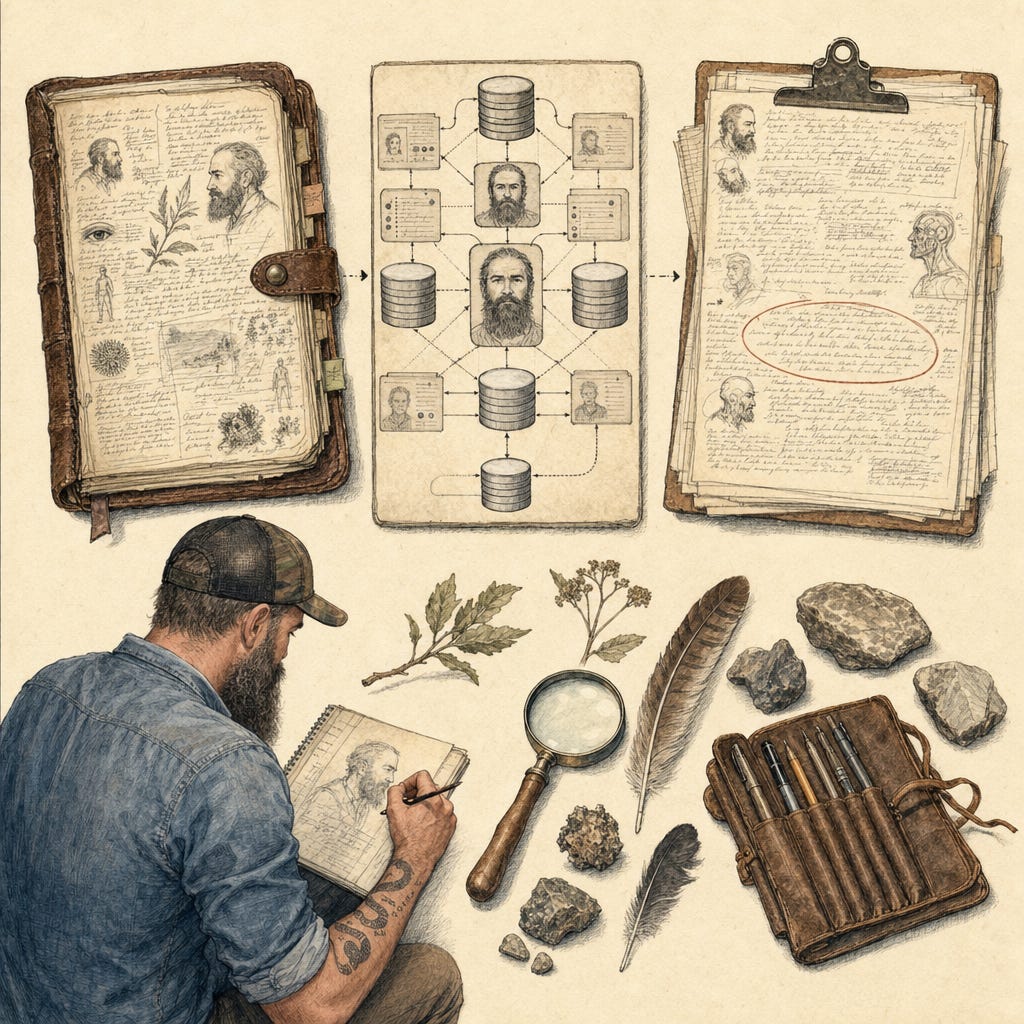
Lee Hopkins is a counselling psychologist in Đà Lạt, Vietnam. He’s AuDHD, diagnosed at 66 after decades of clinical practice and personal compensation. He writes Letters from the Quiet Half on Substack, and he published an article about jonmick.ai called “What happens when a neurodivergent man builds his own brain?”
Lee looked at the system (the sprawl of database tables, the MRI data published on the internet, the 63,000 text messages organized into searchable archives, the phone number connected to an AI trained on my entire cognitive profile) and he didn’t flinch. He assessed it with clinical precision and emotional honesty, validated the WMF framework, acknowledged the research rigor, and flagged the vulnerability exposure with the kind of measured concern that comes from understanding both the courage and the risk.
We had talked a few times before he wrote it, an hour on video at a stretch, and I had told him about worth amnesia: waking up each morning and rebuilding a sense of self from near-zero, and building an entire infrastructure to solve the problem of forgetting, each morning, that you matter. Lee heard all of it, and his article handed it back with a clinician’s precision.
His closing observation: “The building as proof of worth. The documentation as defence against forgetting. The system as scaffolding for a self that does not trust its own continuity.”
Lee didn’t use the term AAC, and neither did I at the time. But that’s what he described. A person whose primary channel for identity (working memory, moment-to-moment self-continuity, the internal narrative that tells you who you are and that you matter) is unreliable. And who built an alternative channel that doesn’t depend on the primary one being online.
That is augmentative, alternative communication in the exact sense the field means it.
A better encoding format
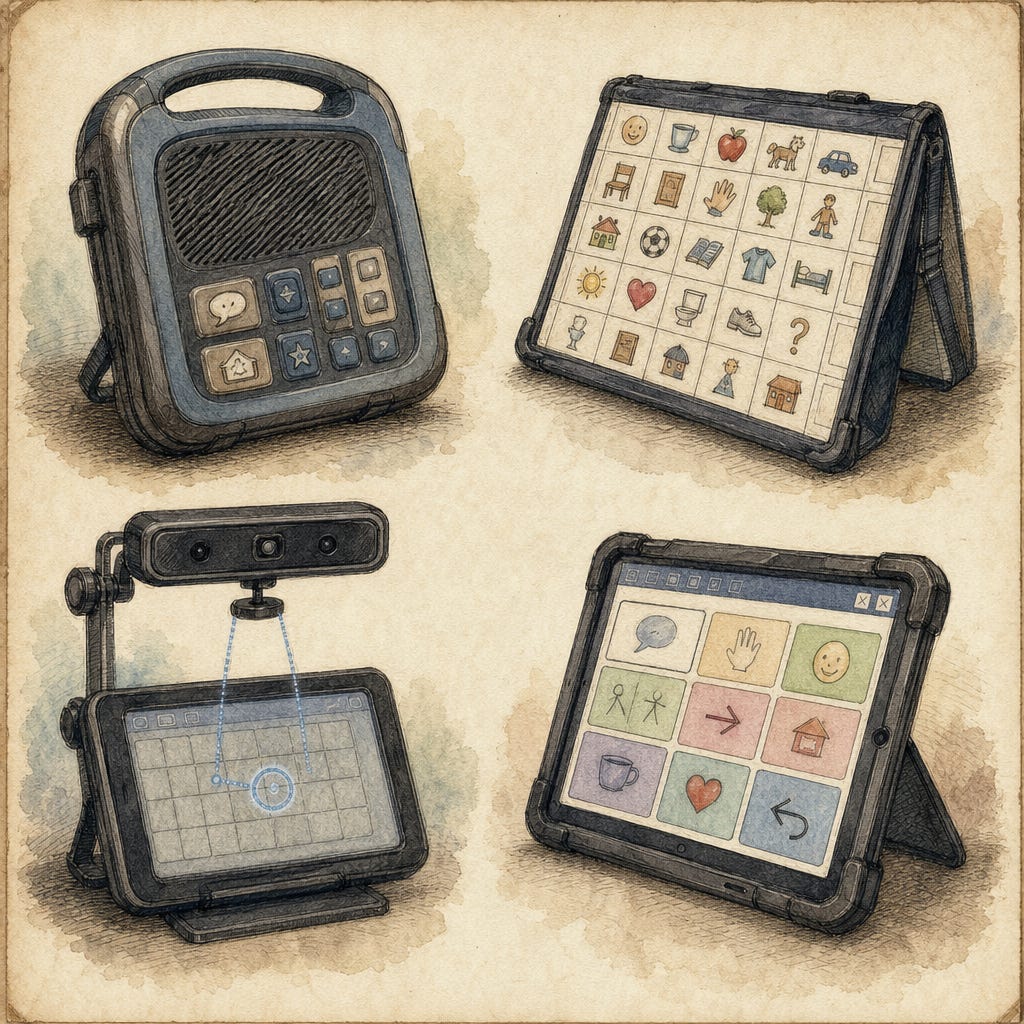
The neurodivergent community fought for the right to communicate through whatever channel works. That fight was about speech, and it was won. AAC is standard practice now, and nobody serious argues that people who can’t produce reliable speech deserve no channel at all.
I thought the sequel to that fight would take years to arrive. It took until July. Substack switched on an AI detector last month, a scanner any reader can point at any post to get back a percentage estimating how much a machine helped, and I published a piece about the people it will misread: a comment thread full of writers describing AI as the first channel that ever kept up with them. The old fight’s logic is being re-litigated in real time, on new terrain, and the asterisk the disability community spent decades removing, the one that says the channel invalidates the message, is being penciled back in by an algorithm.
But even that fight is still about words. The quieter fight underneath it has no name yet. It’s the fight for the right to communicate who you are: identity, cognitive architecture, phenomenological experience, relational needs, the full complexity of a self that doesn’t compress into small talk and doesn’t survive working memory resets intact.
I built four layers of this system before I knew the framework existed. A self-knowledge layer that gave me vocabulary for my own nervous system. An availability layer that carries my identity when I can’t. A relationship layer that translates my experience into my wife’s language and hers into mine. And all of it documented, structured, and persistent in a database that doesn’t forget who I am overnight.
The Napster-era .aac files were a better encoding format for audio: tighter compression with less loss.
What I’ve been building is a better encoding format for the self.
Human. Deeply seen.
Why I write this
Most people get described at low resolution, a stick figure of who they actually are, handed to them by a doctor with nine minutes or a personality quiz or their own worst day. I build the higher-resolution version. It’s called a Life Model: a structured, shame-free read of how your particular mind is built, in a form you can actually use with yourself, your doctors, and the people you love.
If a piece like this lands as recognition and not just an interesting read, that’s usually the signal. Later this year I’m running a small cohort with my wife Charlotte, a trauma-informed yoga therapist, where we build these together. I also do one-on-one builds for people who want the bespoke version. The cohort is paid work, and it’s the first thing I’ve ever charged for that I’d point my own people toward.
Neither is open for enrollment yet. What’s open is a conversation. If you want to talk through what you’re working with and whether any of this would help, just reply, or book a short call. No pitch. And if you want first word when the cohort opens, say so here and I’ll keep you posted.
Nothing short of astounding, groundbreaking and extremely impressive. What you're doing is next level.
I’d like to reference this post in a forthcoming podcast about AI. Thank you for giving me so much to think about.