

TL;DR: My genome says I should be a worrier of the first rank, and the personality instrument I trust most says I’m one of the calmest people in any room. Both are right. Neuroticism is an alarm, and the trait only looks like a disorder when the alarm has no channel. Psychology quietly retired the word in the 90s and handed us “highly sensitive person” instead, and the kinder name hid what the alarm does. I’d like the old word back.
In October I quit a personality test about halfway through.
The test was Elaine Aron’s Highly Sensitive Person scale: 27 questions, free online, five minutes if you answer quickly. I got to one asking whether I get rattled when I have a lot to do in a short amount of time, and I stopped. Rattled compared to what? Compared to whom? I have never once been inside another nervous system. My entire sample for “how rattled a person gets” is one, and he’s the one taking the test.
Question after question assumed a baseline I’ve never had access to. Easily overwhelmed, easily startled, deeply moved. Somewhere in the middle I stopped answering and started arguing with the instrument, which is its own data point, and then I quit. I suspect a lot of people like me bail at the same spot. The test is built for people who grew up knowing what normal felt like, and it quietly flunks everyone who had to reverse-engineer normal from the outside.
I wasn’t taking it out of idle curiosity. This spring, a readout told me I’m neurotic. This fall I finally stopped flinching long enough to look.
The receipt I didn’t ask for
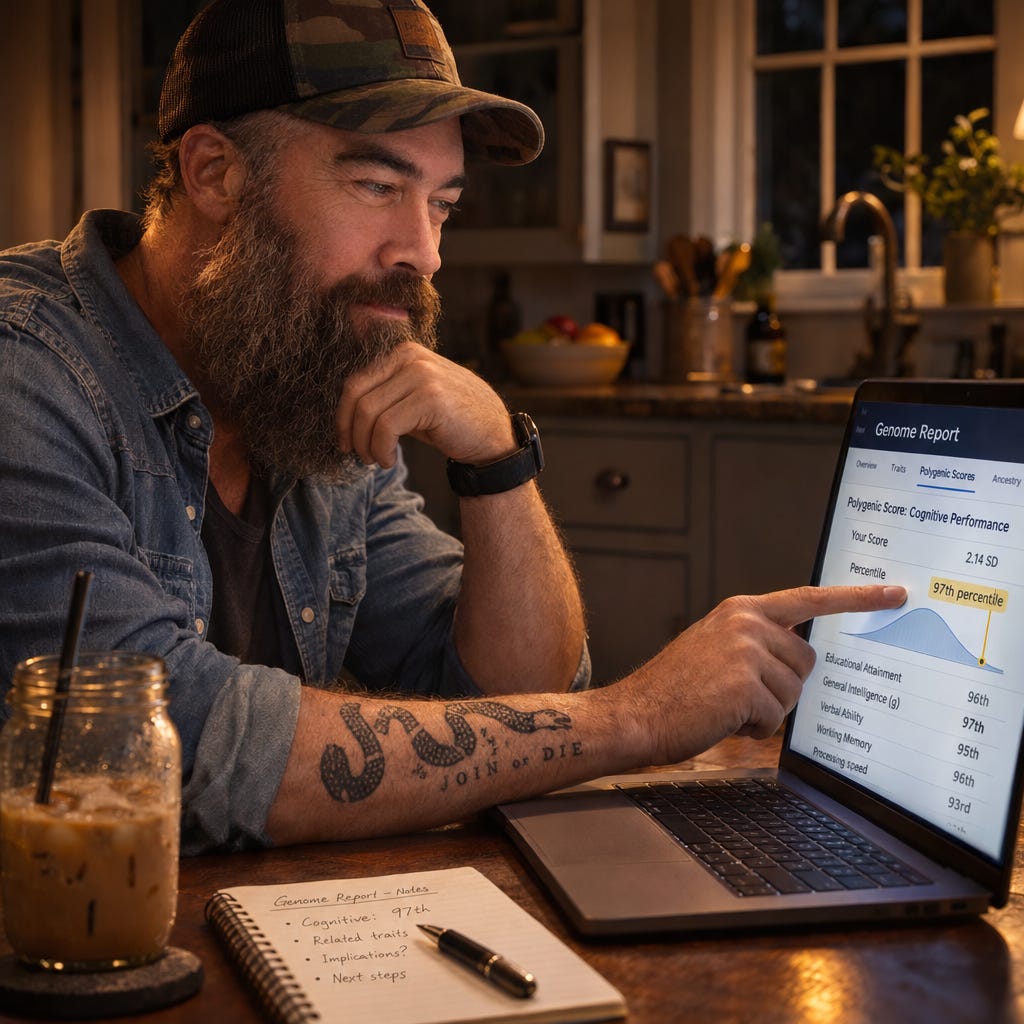
I have a receipt for this one. In May I ran polygenic scores against my whole genome, the kind of analysis that adds up thousands of common variants and places you on a population curve. For neuroticism, the sum landed at the 97th percentile. A second scoring method put it higher still, though that one runs imprecise at the extremes, so I hold it loosely. The anchor is 97. Genetically, I am built to register threat early and hold it long.
I did not want this receipt. I wanted a different one. This newsletter is called AI Gave Me Autism, and the autism in that title has no genetic receipt at all. My polygenic score for autism sits at the 47th percentile, dead center of the pack, which proves nothing either way, since those scores explain a few percent of the variance and miss rare variants entirely. But I noticed where my attention had gone for two years. I built an identity around a trait with no receipt and looked away from the one that came with a stamped, itemized invoice.
My mother, for the record, has never bought the autism. When I told her where the data had landed, her summary of her son was an unusually intelligent brain that is also emotive. She credits whatever I’ve managed in life to intellect and drive. I’m less sure than I used to be that she’s wrong.
The reason is the word. Autism, in the circles I move in, is a word people fought to make sayable. Neurotic is a word nobody says about themselves. It’s a word for other people’s dogs.
And the instrument I trust most says it doesn’t apply to me anyway. On the Big Five Aspect Scales, my Neuroticism score is 11 out of 100. The Withdrawal aspect, the worry-and-rumination half, is 6. One of the calmest people in a room of a hundred, according to the questionnaire, and according to everyone who has known me for less than a year.
The genome says 97. The questionnaire says 11. For a while I read that as a contradiction. It took me months to see it as an architecture.
Nine seasons of George Costanza

The word was in trouble long before I met it. Freud’s “neurosis” was about repressed sexual conflict, which is why “neurotic” still carries a faint whiff of the analyst’s couch. In the 1940s, Hans Eysenck borrowed the term for something cleaner, a temperament dimension measuring how readily a nervous system produces negative emotion and how slowly it settles. The Big Five kept Eysenck’s trait and the name Freud made famous, and the name did what names do. By the time I was in high school, “neurotic” meant Woody Allen. Then it meant George Costanza, who spent nine seasons on Seinfeld demonstrating, with great precision, what a threat-detection system looks like when it has nowhere to send its findings. We laughed because the alarm was real and the channel was missing. Nobody watching that show thought, I’d like to be more like George.
So in 1996, a psychologist named Elaine Aron gave people a name they could use at a dinner party: highly sensitive person. A year later she published a scale for the trait underneath it, which she called sensory processing sensitivity. The research since then has been fairly consistent about what the HSP scale measures. It correlates with neuroticism at around 0.4, and more weakly with openness. When researchers split it into its three pieces, two of them (getting overwhelmed easily, having a low sensory threshold) track neuroticism, and the third (being moved by art and subtlety) tracks openness so closely that one team had trouble telling the two apart. To a first approximation, HSP is neuroticism plus openness in kinder clothes. Not everyone in the field agrees, and that argument is still running.
I don’t say any of that to dismiss it. Aron’s framing carried one idea the neuroticism literature had mostly skipped, and I’ll get to it. But notice what the renaming did. It made the trait sayable by moving it away from the people everyone was already laughing at. Neuroticism became a word for researchers to use about other people, and the people who carry the loading stopped claiming it, because who would? You can’t rehabilitate a word if nobody will admit it applies to them.
I’m admitting it. Ninety-seventh percentile, with the paperwork to prove it.
An alarm, a wide lens and a governor
What neuroticism does, mechanically, is lower the threshold for threat. Negative signals register sooner and stay longer. A neutral face reads as disapproval a beat before anyone else would read it that way. A mistake costs more. The replay runs longer. Researchers split the trait into two halves, withdrawal (the worry side) and volatility (the irritability side). Mine measure 6 and 25, which tells you the questionnaire version of me rarely worries and almost never flares.
Giftedness, which I’ve written about before in The G-Word, does something different. It takes in more and finds patterns faster, which also means it can simulate more futures. Put the two together and you get a mind with more material to worry with. One study found that higher verbal intelligence went with more worry and rumination, and I believe it, because a mind that can run six branches of a conversation can find the threat in five of them.
My coach, John Syc, pushed back when I filed the intensity under giftedness. In his read, the intensity belongs to the neuroscience of denser, less-pruned wiring more than to gifted studies, and the research that explains it sits in other fields. He’s probably right, and it’s part of why this piece wears the older word.
The same capacity builds something else, and that is how 97 reads as 11. In The Trauma of a Brain That Runs Hot I called it the Cognitive Bodyguard, the move my intellect makes to convert a feeling into analysis before the feeling finishes arriving. What I didn’t see then is that the Bodyguard also works as a governor on the alarm. Intellect scores at the 92nd percentile on the same instrument that scores my Neuroticism at 11, and those two numbers are related. The capacity that feeds the alarm also runs it. The calm you meet is real, and it’s built, and it has been under construction since before I had words for any of this.
I know it’s built because people watched me build it. More than one friend in high school told me they wanted to be there the day I finally blew up. They could see the managed calm and the pressure underneath it, which means the governor already looked like work to the people around me when I was a teenager. For the record, they never got the show. I didn’t get angry at a single one of them.
My mother saw something different from the same years. To her I was the family rock: steady, calm, funny, the kid who laughed off trouble. When I told her I’d had frequent bad feelings as a child, it surprised her. The friends in the next room saw the pressure; the person in the house saw the rock. Both were watching the same governor from different distances.
She remembers the exceptions better than I do. The few times the alarm got through were all with people I was attached to: my brother, his friends, and later Rachael, who years afterward became my first wife and Jack’s mom, when I felt rejected by her. It took one of two forms, she says: visibly upset and arguing, or shut down entirely, what she calls dumbfounded. The trigger, as often as not, was fairness. Everywhere else, the governor held. In the one channel where attachment was on the line, it didn’t.
That’s the shape of the whole thing. The alarm runs loud, and the governor holds it down everywhere except the one place where someone I want can say no.
Rattled compared to what?
I remember having strong, frequent bad feelings as a kid, and I assumed every kid lived like that. My first clue otherwise came decades later, watching my son grow up without that weather. My mother once told me on the phone that she’d always had a good her and a bad her, the self she showed the world and a secret one, and that she assumed everyone was built that way. Two generations, same assumption, and neither of us had a yardstick. Anxiety runs in the family, she said. So, apparently, does the yardstick problem.
Psychometricians have a name for it. They call it the reference group effect. When a scale asks how easily you get overwhelmed, your answer depends on which “most people” you carry around in your head. Cross-cultural researchers found it when people in each country rated themselves against their own countrymen instead of against the rest of the world. For a twice-exceptional kid, the reference group is a population of one. I never absorbed what normal felt like from the inside, because the inside was always mine. I reverse-engineered it from the outside, the same way I reverse-engineered how to walk across a room toward a girl, and reverse-engineered normal is a poor yardstick for “easily.”
So the HSP scale (mostly questions about being overwhelmed, with the comparison left for me to supply) cannot measure me, and I’d bet it cannot measure most of the people reading this. Autism researchers hit a similar wall with their own questionnaires. In one clinic study, nearly two-thirds of the adults who scored below the screening cutoff were autistic anyway. And the adults who camouflage most effectively appear to be the ones who go undiagnosed.
Aron earns her place on one point the neuroticism literature had mostly skipped. Sensitivity cuts both ways. Researchers who study this talk about dandelion children, who do fine almost anywhere, and orchid children, who wilt in a bad environment and bloom in a good one. Michael Pluess gave the blooming its own name, vantage sensitivity. The same wiring that makes a harsh room cost more makes a good room pay more. In the early studies, sensitive kids got more out of the same support than other kids did, whether it was a warm home or a school program meant to prevent depression. For someone built this way, the people in the room matter more than usual, in both directions. Neuroticism research mostly counted the harm. HSP counted the upside and lost the word. I’d like the word and the upside together.
What that means in practice, for me, is measurement that doesn’t require a normal. My recovery data after a loud evening. How many hours it takes me to settle after a work trip. My working theory, from a brain map and a lot of loud restaurants, is that the drain comes from scanning the room, with the volume a distant second. None of that asks how rattled I get compared to the average person. It asks what my body did.
I’m neurotic. I’ve been practicing the sentence, and it lands differently from “I’m a highly sensitive person,” which asks for gentleness, and differently from “I’m autistic,” which, in my case, asks you to take my word for it. “I’m neurotic” comes with a receipt, and the receipt describes an alarm wired into a mind that can see more than most rooms want to hear about. For most of my life the people closest to me could see the governor working, and a few of them were curious enough to wait around for the eruption that mostly never came. The 90s gave that trait a sitcom. Then psychology gave it a softer name and let the old one die. I think the old one was telling the truth. The alarm was always doing its job (the receipts get their own essay). What it needed was a channel, and a few people patient enough to stand nearby while I built one.
Human. Deeply seen.
Why I write this

Most people get described at low resolution, a stick figure of who they actually are, handed to them by a doctor with nine minutes or a personality quiz or their own worst day. I build the higher-resolution version. It’s called a Life Model: a structured, shame-free read of how your particular mind is built, in a form you can actually use with yourself, your doctors, and the people you love.
If a piece like this lands as recognition and not just an interesting read, that’s usually the signal. I’m close to opening a small cohort with my wife Charlotte, a trauma-informed yoga therapist, where we build these together. One-on-one work is open now. A Scaffolding Session is one dedicated hour to say the whole messy thing out loud and leave with your own next move, and if you want the bespoke version (a full Life Model build), we can talk about that too.
Either way, it starts with a conversation. If you want to talk through what you’re working with and whether any of this would help, just reply, or book a short call. The first call is free. No pitch. And if you want first word when the cohort opens, say so here and I’ll keep you posted.
I consider myself HSP as I ran into that long before anything else except the MBTI (INFP by the way). My DNA has a double slow COMT, so super worrier I guess😆 my cognitive assessment could not fit me into anything and my sensory sensitivities were a bit higher than autism. I test with high openness. I grew up in a really bad home too. My nervous system’s normal is high alert.