

TL;DR: My brain runs hot for two reasons, and they feel identical from the inside. One is architecture: wiring I was born with, mapped by scans and a paper trail, mine for life. The other is trauma: a lifetime of being too much and not enough, converted into a defense that runs at the same temperature. I neuro-affirmed the first for a year while the second hid inside it. This year they finally came apart.

In May of last year, I told my coach, John Syc, I felt like I was driving a Ferrari with bad brakes and the alignment off, yelling out the window for help because the thing was going fast and I did not know how to stop it. The metaphor did its job, which is to hand someone the inside of your head without making them live there.
That summer he handed it back with a question attached. How did I know whether the speed was coming from trauma, or from embodied presence, from the way I am actually built?
I did not have an answer. I had a hypothesis, a plan to get my brain scanned, and 700 browser tabs.
The case for the wiring
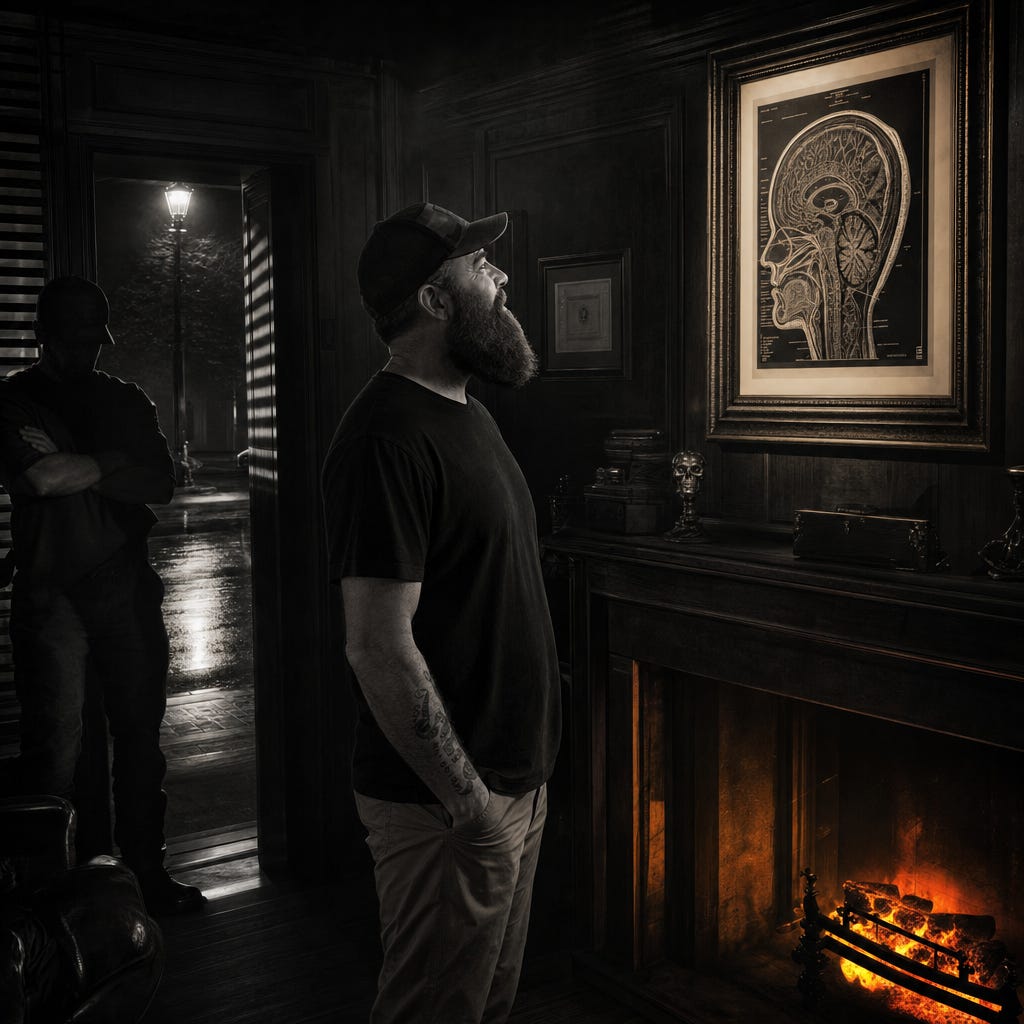
The scan happened. So did the genetics, and eventually a paper of my own on ADHD and working memory. The architectural case assembled itself over about a year, and every piece of it was a relief.
The QEEG put numbers on the speed. Eighty-five percent of the connectivity measured in my beta band, the brain’s working rhythm, came back high: networks locked in constant coordination, unable to downshift, an engine stuck at high RPM because the transmission cannot find a lower gear. My neurofeedback specialist, Gil, walked me through the maps, and for the first time “just relax” sounded like what it is, a category error.
Working memory fragility explains most of the rest. Mine drops the thread mid-thought, so the whole system compensates: constant reconstruction of context, relentless pattern-scanning, and storage outsourced to the environment. The 700 tabs are external RAM. The intensity is the system working.
Every piece of this evidence lived outside my body. I could print it, cite it, hand it to a skeptic. Neuro-affirming the wiring was easy because the wiring came with receipts. The Ferrari finally had a spec sheet, and I have never loved a document more.
For a year I thought that settled my coach’s question. Heat equals architecture, architecture equals me, case closed, next mystery please.
The heat with no receipt

“Too much and not enough” arrived before any diagnosis did. Too much in every register that mattered, and somehow not enough of whatever the room was grading on. Run that verdict across a whole life and it does not get stored the way a car accident gets stored. There is no single memory to point at. Therapy shorthand sorts trauma by size, big-T for the single catastrophe, little-t for the drip that never makes a chart. Little-t trauma is a climate, and a nervous system raised in a climate stops registering it as weather. It just calls the bracing “me.” Heidi Priebe, who covers attachment and complex trauma on YouTube, describes the deeper cost of that kind of climate as losing your sense of proportion: the missing comfort is only half the damage; the other half is a broken gauge for what counts as hard, so you spend adulthood underpricing your own load.
My coach drew the line for me in a session last fall. Intensity, he said, is what overexcitable architecture produces, and intense does not have to mean overwhelmed. A sympathetic state, the body braced for threat, is a different animal, and a lifetime of unwitnessed intensity had parked my baseline there. The wiring made the heat. The history decided what the heat meant, and it decided danger.
I understood the distinction immediately, the way I understand most things, which is thoroughly and from a safe distance. It filed neatly into the framework. That turned out to be the tell.
I call the mechanism the Cognitive Bodyguard: the protective move by which my intellect converts emotional or relational experience into framework, language, or analysis before the felt experience fully reaches my body. I refuse to call it broken. It is the same metabolic process that produced my working memory theory, this newsletter, and most of my structured self-knowledge. But its job description is defense, and it works the door of my own interior with alarming diligence. I once said out loud, in a session, that intellectualizing, planning, and perfecting might be a trauma response. I said it while actively maintaining a personal database that has, at last count, more than 180 tables, which is what intellectualizing looks like once it gets a budget.
Same temperature, different fuel

So there are two heats. One is generative: the pattern-scanning, the connection-making, the mind that reads six layers into everything because six layers are actually there. The other is defensive: the monitoring that runs underneath every conversation, computing what my coach once called the algorithm of what the other person needs, checking whether I am safe, whether I am being seen accurately, whether the too-much is showing.
I can hand you the two heats as a pair of documents. After a minor conflict with my mother-in-law, I once spent two hours writing an analysis of the dynamic between us instead of raising it with her. That document is the Bodyguard, monitoring gone to print. I also have a two-page Mother’s Day plan that took the same two hours, built while researching local events. That one is the architecture, the same engine scanning on someone’s behalf instead of against a threat.
They produce the same temperature. From the inside, at speed, I could not tell you which one was running, and for most of my life I never had to, because they were fused into one continuous heat that I filed under “personality.”
Which is why my only treatment plan for years was a sticky note that said slow down. Notice what that instruction does. It brakes the whole engine. It cannot distinguish the scanning that writes theory from the scanning that checks for exits, so it dampens both, and it quietly pathologizes the exact thing I keep insisting is not pathology. It is also, structurally, a demand, and my nervous system files demands under threat, including the ones I issue myself. A self-command is just a demand in a trench coat. I was prescribing a speed limit for a fuel problem. It failed at the only job that mattered, telling the two heats apart.
What finally moved was a practice, and it is embarrassingly small. These days I can sometimes catch the Bodyguard mid-conversion, in the moment a feeling starts turning into a paragraph. And instead of finishing the paragraph, I put the pen down and sit in the feeling until it completes, with no documentation and no framework. My coach told me I could not think my way through this part, that I would have to feel my way through it, and I would like the record to show that he was right and that I hate it. Priebe lands in the same place from the trauma side: healing this layer means becoming more sensitive rather than tougher, catching the load at a four out of ten instead of waiting for the collapse at a nine.
The tell between the two heats, when I can find it, is function, and the question I have learned to ask is what the heat is doing. Making something? Or checking whether I am safe? The first one is mine; the second is history doing an impression of me.
Why I saw it in someone else first

Recently I watched someone describe their own version of the heat, and my first thought went to their trauma, to the climate that taught their system to brace. The same read, aimed at myself, has taken years.
That asymmetry turns out to be standard issue. A defense that is still on duty announces itself as personality, as preference, as “I’m just wired this way,” a sentence that in my case is half true, which makes it an excellent place to hide the other half. You cannot see the water you are swimming in. You can see it fine in someone else’s aquarium.
I can testify to how well it hides, because mine hid from every qualified person in the building. I learned I have C-PTSD, the complex kind, which in my case built from accumulation rather than a single event, from insurance paperwork: the diagnosis sitting in a code on my coach’s reimbursement form. He explained it. I took it to Gil anyway, who had been reading my brainwaves for months, and Gil confirmed it and added EMDR to the protocol. Two practitioners in, Charlotte still didn’t buy it, for the same reason I hadn’t: the version of me she knows had no slot for it. She brought it to her own therapist, who knows me too, and was told, without hedging, that her husband has C-PTSD. Three professionals, one wife, and the diagnosis had been sitting in plain sight the whole time, which is apparently the one place nobody checks.
So I came home carrying the obvious question: how much of it do I still have? And I think that question uses the wrong unit. Trauma does not read off a gauge. What I can actually observe is fusion, whether the two heats still feel like one thing. They used to, completely. Now, some days, they come apart while I am still in the moment. Differentiated is a long way from resolved. I will take it anyway.
What each layer gets
The practical payoff of pulling them apart is that each layer finally gets the right treatment, and neither gets shame. The wiring gets infrastructure: external scaffolding, honest documentation, a life built around how the engine actually runs. You do not send a Ferrari to therapy for being fast. A prior therapist once heard me describe the heat and compared it to drinking, something to do less of. I fired her. That is the confusion running the other direction, a professional reading wiring as wound and prescribing less of me as the dose. The wound gets something slower: bottom-up work, felt rather than framed, done with people trained for it, at a pace my Bodyguard finds insulting. Neurofeedback that reaches the body before the narrative does. Coaching calls where the most useful thing I do is stop explaining. Some evenings, for me, the support is chemical: a measured dose of THC sends the Bodyguard on a lunch break, and a feeling gets to finish in the body before the analysis arrives to collect it.
John is careful with me about one more distinction, because the tidy ending would file the wound next to the wiring as a second permanent resident. He respects the biology under the bracing. He refuses the determinism, the move where a label hardens into a life sentence. And he speaks from the far side of the work: the restriction he carried dissolved as the healing landed, and the restraint still in his life answers to his values rather than to a condition. He has even reassigned my reading, out of the chapters on coming apart and into the ones on post-traumatic growth, Fisher and van der Kolk both. I am holding that as testimony rather than promise. The wiring is the lifetime appointment. The wound might only be visiting.
If your brain runs hot, both stories might be true at once. Some of your heat is architecture: yours, permanent, worth building a life around instead of apologizing for. And some of it may be a nervous system that learned, early and often, that intensity gets punished, and is still bracing for a verdict that stopped being rendered years ago. Asking which is which will not pathologize you. The wiring deserves a spec sheet. The wound deserves a witness. Confuse the two and the wrong one gets treated, and for most of my life, the wrong one did.
The heat is going nowhere, and I have stopped wanting it to. What I want now is to know, in the moment, what it is burning. On the good days, I can tell. And on the days I cannot, there is someone across the table, or across the kitchen, who can see my aquarium just fine.
Human. Deeply seen.
Why I write this
Most people get described at low resolution, a stick figure of who they actually are, handed to them by a doctor with nine minutes or a personality quiz or their own worst day. I build the higher-resolution version. It’s called a Life Model: a structured, shame-free read of how your particular mind is built, in a form you can actually use with yourself, your doctors, and the people you love.
If a piece like this lands as recognition and not just an interesting read, that’s usually the signal. Later this year I’m running a small cohort with my wife Charlotte, a trauma-informed yoga therapist, where we build these together. I also do one-on-one builds for people who want the bespoke version.
Neither is open for enrollment yet. What’s open is a conversation. If you want to talk through what you’re working with and whether any of this would help, just reply, or book a short call. No pitch. And if you want first word when the cohort opens, say so here and I’ll keep you posted.
What an enlightening journey you're on. So glad to have a front row seat to your aquarium. I've heard that looking at an aquarium is equivalent to meditation in the physiological sense. Reading your work and see the process unfold is definitely keeping me grounded in my journey. Thanks for your writing.