

TL;DR: Reaching toward another person is a distinct neural event your brain assembles in the seconds before you move, rather than a character trait you either have or lack, and in my brain that event runs quiet. New whole-brain neuroscience and my own QEEG arrive at the same place from opposite directions: social approach is a generated, measurable, trainable process. This is the architecture of approach. It is also the piece of myself I had to build on the outside before I could grow it on the inside.

The first time I remember failing at this, I was four, maybe five years old.
Both of my parents were earning master’s degrees, and one summer our family lived on the campus of Northern Arizona University while they did it. To get room to study, they tried dropping me at a day camp. I remember those days with the clarity one reserves for the things that hurt. I could not approach the other kids. Not one of them. The move toward another child, the thing that for all of them looked as automatic as breathing, simply had no ignition in me. So I made no friends, and I spent the days alone in the middle of a crowd of them. After three of those days, my parents quietly pulled me out.
I did not have a single word for what was wrong. I was four. I only knew that the other kids could do something I couldn’t, and that the something was so basic nobody else seemed to notice it was a something at all. It would take me decades, and a map of my own brain, to understand what that kid was actually up against.
By fifth grade, I had at least turned it into a strategy. I read Men Are from Mars, Women Are from Venus, the same paperback I wrote about last time. What I left out then is that I stole it from my dad's bookshelf, the way other kids stole their dad's Playboys. I had decided, without ever deciding it, that connection was a subject. Something you could study your way into if you were diligent enough about the reading. (Don’t worry; it all works out with the girls just a few years later.)
The studying never converted. I knew, in a thorough and well-cited way, how I was supposed to walk across a room toward a girl I liked. I just could not get my body to launch. The plan was complete. The execution never fired. Years later, eHarmony would feel like a small miracle because it had solved my problem: it turned the approach into a series of asynchronous prompts I could respond to instead of a move I had to generate from a cold start. Give me something to react to and I am fluent. Ask me to make the first reach into silence, and the machinery just sits there.
In my early life, I filed this under shyness. Then, during adolescence, I blamed it on how I looked and talked. On bad days, it was something more like a verdict: that I was, at some basic level, less built for this than other people. What I did not have was a better explanation. So the verdict stuck, the way verdicts do when nothing shows up to contradict them.
Then I saw it on a brain map, and shyness was never what it was.
The thing shyness wouldn’t explain
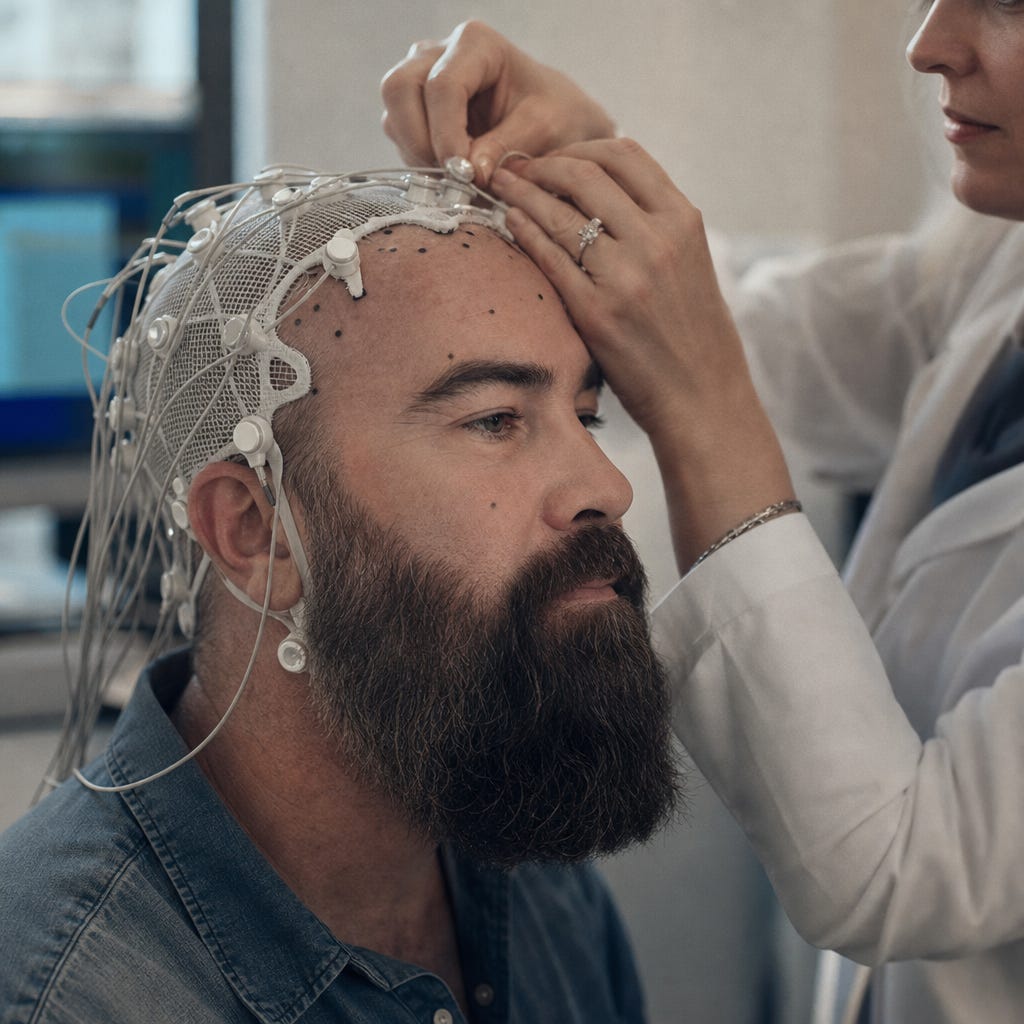
When Gil ran my QEEG, one of the findings was a left-dominant frontal alpha asymmetry. In plain terms: the executive front of my brain idles inward when it should be turning outward. The clinical note attached to it is almost rude in its precision. It reads as under-activation of the brain’s left-frontal approach-motivation systems: reduced drive, a contemplative and detached cast, a system tuned to observe rather than to initiate.
There is a whole literature behind that one line. The relative balance of activity across the left and right front of the brain tracks a basic motivational direction: lean left and the system is tuned to move toward things, lean the other way and it is tuned to pull back. Mine leans the wrong way for approach. The thing I had spent thirty years reading as a personality, or a failing, had a location. It sat at a spot on my scalp Gil can point to. F3.
There is a second finding that took another eight months to surface. When Gil re-scanned me last spring, after the stress markers had come down, a classic ADHD presentation appeared underneath that the first scan had never shown. My brain had been running hyperarousal to cover for an underaroused frontal system. Take away the noise, and what the noise had been standing in for became visible. The quiet approach circuit was part of it.
I cannot tell you how much it reorganized me to learn that. A brain map is not destiny, but “I am bad at reaching for people” and “my left frontal lobe under-activates its approach circuitry” are different kinds of sentences. The first one is about my worth. The second one is about my wiring. Only one of them is true, and it is the one with coordinates.
This is the thing I keep circling in everything I write. Specificity dissolves shame. Shame needs the vague version to survive. Give it a mechanism and a location and it has nothing left to grip.
There is no approach button
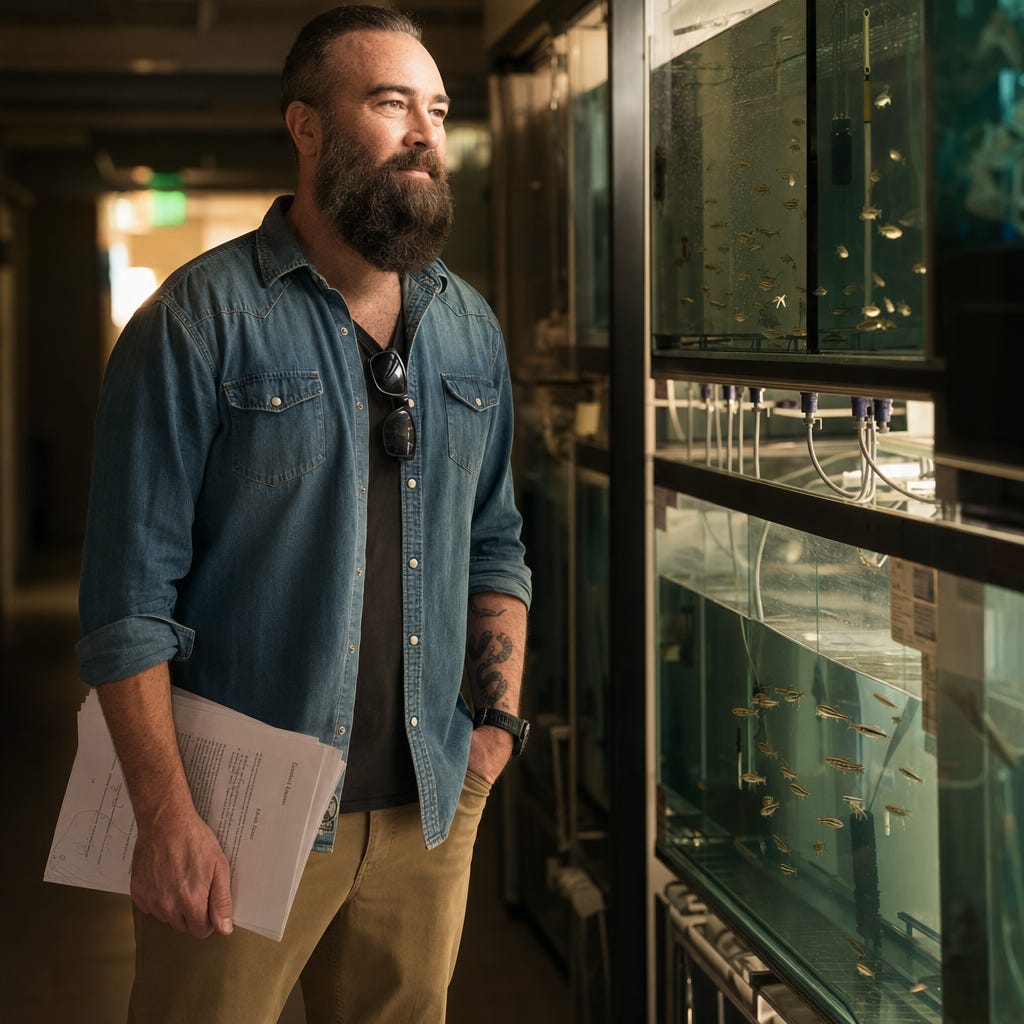
A 2026 study out of Lilach Avitan’s lab at Hebrew University, published in Nature Communications, went looking for how a brain decides to move toward another of its kind. They used zebrafish, because a young zebrafish is nearly transparent, which means you can record almost its entire brain, one cell at a time, while it is actually behaving. They held the focal fish gently in place, head fixed but tail free to swim, and let it watch a second fish moving freely on the other side of a clear barrier, then tracked what happened in its brain right before it chose to approach.
What they found is that approach is not spontaneous. Several seconds before the fish makes any move toward the other one, a distinct, brain-wide signature switches on. Activity climbs in the pallium, a deep forebrain region, and drops in the midbrain and hindbrain underneath. That pattern is specific enough that you can read it and call the approach before the fish has so much as twitched. It only shows up for a real social partner, not for a moving dot following the same path. And when they used a targeted laser to ablate that small population of pallial neurons, the fish’s preference for being near other fish dropped sharply, and the predictive signature disappeared along with it.
There are two details here.
The first: there is no single “social center.” The approach is run by a coordinated shift across several regions at once, talking to each other, pulling in opposite directions to generate the lean toward another body. The function is spread across the brain rather than parked at one address.
The second: the strength of that pre-decision signature varies from individual to individual, and it predicts how social each fish is overall. Some of the fish, roughly a third, barely engaged at all, and you could see it in the muted signal. Their approach machinery simply ran quiet, which is a different thing entirely from being broken.
Read that back through what I just told you about my own brain and the overlap is hard to miss. Sociability, the raw drive to close the distance toward another creature, is a quantity the brain generates. It runs strong in some and quiet in others, and the difference is legible in the tissue before the behavior ever happens. The reach has its own dedicated machinery. Mine, like that quiet third of the tank, runs low.
That makes low approach a parameter with a signature rather than a verdict on my character.
My theory, with fins

I have spent the last couple of years building a framework I call working memory fragility. The short version tends to surprise people. My working memory is losing a race rather than running out of room: ideas arrive faster than my mind can set them, so the newest one overwrites the last before it lands. My brain compensated the way brains do, by pushing enormous load down into older, deeper systems: the basal ganglia, the cerebellum, the parts that run procedures and patterns underneath conscious awareness. My published ADHD paper makes the longer case, that this is an alternative architecture rather than a broken-standard one, with the heavy lifting happening below the cortex.
The fish study is, more or less, that thesis wearing a wetsuit.
The approach engine those researchers found does not live in anything resembling a prefrontal cortex. The pallium is an old, limbic structure, the fish relative of the hippocampus and the amygdala, and its closest neighbor in this circuit is the relative of the basal ganglia. The sustained, several-second pre-decision signal they describe is the same kind of slow build that other groups have traced into the cerebellum. In other words, the machinery for moving toward another being is distributed and it runs underneath. My QEEG tells the same story from the inside: the analysis found my brain compensating for weaker structural wiring by cranking up functional connectivity, leaning hard on cerebellar pathways. It is the same architecture showing up in a different species, read through a different instrument.
Hype is cheap and precision is the entire point of what I do, so: a zebrafish pallium is not my F3. It is a limbic structure, not a piece of frontal cortex, and the fish does not even have a clean equivalent of the prefrontal region my neurofeedback targets. So the two pictures do not agree on the wiring diagram. What they agree on is the computation: that approach is a distinct, generated, individually-scaled process the brain assembles before you act. Where the anatomy actually lines up is the part underneath, the subcortical part, and that is the part my whole framework is built on. The convergence I get to claim is real. It is just one floor lower than the headline.
Functional, not structural
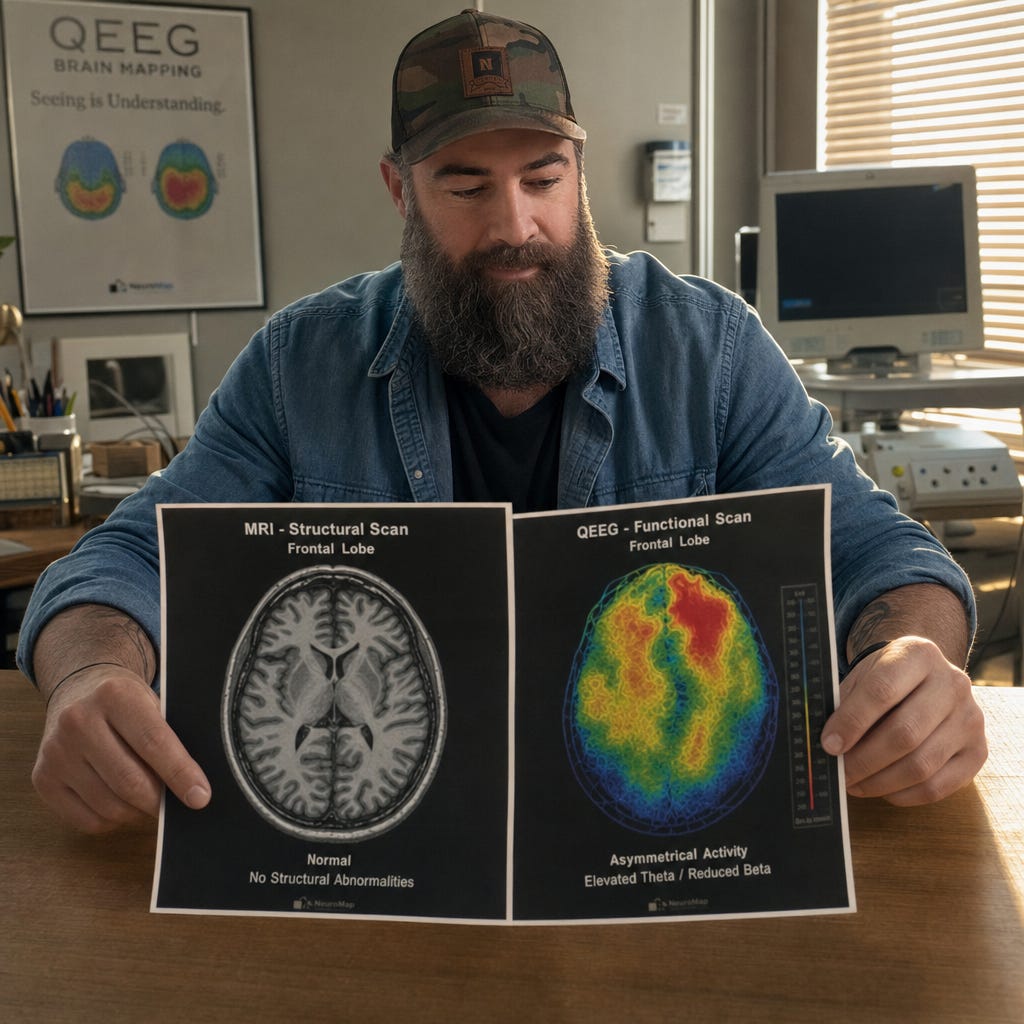
When Gil cross-referenced my MRI against my QEEG, he confirmed that my prefrontal cortex is structurally normal, full in both volume and thickness and intact throughout. The frontal slowing, the under-activation, the quiet approach circuit, all of it has a functional origin. The hardware is fine. The problem is in the dynamics, the patterns of activity, the way the system has learned to idle.
“Functional” is an important word here. Structural damage is something you adapt around, while a functional pattern is something you can train.
Which is exactly what I did. From the middle of April to the middle of June I ran a neurofeedback protocol at T3 and F3, and then the course ended and I have not been running anything since. The T3 site was housekeeping, calming an old slow-wave signature my temporal lobe carries, most likely from an ATV accident I took as a teenager, without a helmet, a story for another day. The F3 half is the one that matters here. F3 was aimed straight at the approach-motivation deficit, and the training rewarded my left frontal lobe for coming up out of that inward idle and holding a more outward, engaged rhythm. Eleven sessions of it, on a protocol built around the exact circuit the fish study would call the approach engine.
And I think it took. Enough time has passed since the last session to tell the difference between an effect that lives on the training day and something that stayed. My body did the same thing, and I wrote about it last time in I Was Late to My Own Body: coming online years after it should have, after a long stretch of being something I observed rather than inhabited. This is that same thaw from a different angle.
Things that used to leave me flat have started to land. I catch myself wanting to close a distance instead of studying it from across the room. The reach, the actual generative reach toward another person, has begun, in small and unmistakable ways, to fire on its own.
Why the reach was always the hard half

Approach, specifically, was the function that ran quiet, while so much else in me runs hot.
This whole series turns on a distinction I’ll remind you of: I have two modes, and they are not equal. In responsive mode I am fluent. Put a live person in front of me, a conversation already in motion, a document to react to, and I can go all day. In generative mode I stall. Generative mode is producing the thing from nothing, making the bid, the desire, the request, the first move, with no external input to bounce off of.
Important distinction. None of this is about being seen, and it is not about talking to people either. I have never had trouble being noticed. I was the kid voted Most Unique, the class president, the one on the homecoming court, the one who walks into the center of the party rather than hovering at the edge of it. And I talked constantly. At sixteen I had a private line in my bedroom and I made my rounds every night, working down a list of names, half of them girls I thought were beautiful, talking about nothing for hours. Girls asked to be added to the rotation. Holding a room and holding a phone call are both responsive performances: the other person hands me something and I work with what I am given. That part has always been fluent.
What stalls is narrower than that, and worse. It is the moment the exchange has to carry something I want. Telling one of those girls I liked her. Asking for the date. Making the move that turns an easy friendship into a question she has to answer. I could talk to her all night. I could not cross the distance between talking and wanting. Being seen is a stage I am comfortable on. Wanting out loud is a bid I have to generate, and the generator is the part that runs quiet.
Some of my evidence that being seen was never the problem is, frankly, ridiculous. I did not stay that lonely four-year-old, and the way I climbed out is instructive. By junior high I had found a fix: I rode to school with a loudspeaker bungeed to my bike, blasting Ace of Base or George Michael at full volume, depending on the morning. On the first day of seventh grade, while every other new kid was trying to dissolve into the lockers, terrified of being seen, I was announcing myself to the entire parking lot. I had figured out something I could not have put into words. If the surface was big enough, the world came to me. I did not have to cross the room and start; the room turned around and started with me. Being seen had become the way I never had to make the first move.
Which worked, right up until it didn’t. The surface solved the four-year-old’s problem completely and did nothing at all about the other one. You cannot build a stage big enough that someone else says it for you.
Reaching toward someone is the purest generative act there is. You make the bid before you have the answer. You send the signal out into a silence and you have to sit in the gap between the asking and the response, and that gap is precisely where my anxious attachment and my rejection wound have always set up camp. Of course the approach was the thing that wouldn’t launch. It asks the one mode I am weakest in to operate in the one emotional context most likely to set off the alarm. The text I still owe you that has been sitting unanswered for a week is the same stall in a quieter key, the same gap, the same silence I cannot generate my way into.
So my brain did what my brain does. It declined to fire, and it sent me to the bookshelf instead.
Wanting out loud

On my second date with the woman who is now my wife, fifteen years ago, I told Charlotte I was going to kiss her. Then I waited about two hours before I actually did. I want to be clear about how that felt from the inside: it was terrifying, and there was nothing smooth or confident about it. It was also, at that moment in my life, heresy. I was deep in the Red Pill while I was dating Charlotte. I had gone looking, after my first marriage ended, for somebody willing to write down explicitly how attraction and desire actually operate, and that subculture will absolutely hand you a manual. Every page of it says a man takes the moment. He does not announce it two hours out and then wait for permission. I had the playbook open on my desk and I did the opposite of what it said, and I understand now exactly why.
I could not generate the kiss from a cold start. What I could do was say the thing out loud and then watch for the one input my brain actually needed, which was simple: she was still there. Two hours of her not leaving was the evidence that finally let me move. I had turned the most generative act I knew into a responsive one.
The pickup artists and the dating coaches could never have taught me this, and I would know, because I read them for years. They were answering a question I was not asking. The same announcement that handed my brain its evidence handed Charlotte, who carries her own history into a moment like that, exactly what her nervous system needed. She knew what was coming, and she had the room to decide how she wanted to meet it. The thing I built to get around my own wiring turned out to be the most trauma-sensitive thing I could have done for hers. That is the whole method in miniature, fifteen years before I had any language for it: build the surface, wait for the world to respond, and let the response be the permission to move.
When the generator will not fire from a cold start, and the working memory will not hold the relational learning long enough for it to stick, you are left with one move that actually works. You build the thing on the outside first. You externalize it. For me that has meant years of constructing a system that holds enough of me, across enough time, that the reaching can be rehearsed and revisited instead of dissolving by morning. My self-knowledge lives in infrastructure now, because the buffer that was supposed to hold it could not. I have been building surfaces since that loudspeaker on my bike; the Life Model is only the most honest one I have made. That externalized map is the whole reason any of the inside work became possible, and it is the thing I am quietly building for other people too, as the scaffold the reach can grow on rather than a substitute for it.
The scaffolding was only ever the precondition, never the destination. Building the structure on the outside created enough specificity to dissolve the shame. Dissolving the shame let the body come online. The body coming online is what is now letting the approach fire on its own. Cognitive, then somatic, then relational, in that order. I lived it backward, one improvisation at a time, and only understood the sequence looking down from above once the map existed to look down from.
I used to think the people who could just say it out loud had something I was missing. In a narrow, literal, neurological sense, they do. Their approach circuit runs louder than mine. But that was never the same thing as them being more worth loving, or me being less capable of arriving. It only meant their reach was native and mine had to be built.
If reaching toward other people has always felt like a second language you had to study rather than a first language you could speak, the finding underneath all of this is worth hearing plainly. You are running a particular architecture with a particular approach signal, set to its own volume for reasons that have a location, a history, and, it turns out, a training protocol. That is a different claim than being a broken version of the standard model, and it is the one the evidence actually supports. The reach can be built around, it can be trained toward, and a reach you had to build is still a way of arriving at another person.
Human. Deeply seen.
Why I write this

Most people get described at low resolution, a stick figure of who they actually are, handed to them by a doctor with nine minutes or a personality quiz or their own worst day. I build the higher-resolution version. It’s called a Life Model: a structured, shame-free read of how your particular mind is built, in a form you can actually use with yourself, your doctors, and the people you love.
If a piece like this lands as recognition and not just an interesting read, that’s usually the signal. Later this year I’m running a small cohort with my wife Charlotte, a trauma-informed yoga therapist, where we build these together. I also do one-on-one builds for people who want the bespoke version.
Neither is open for enrollment yet. What’s open is a conversation. If you want to talk through what you’re working with and whether any of this would help, just reply, or DM me via Substack chat. No pitch.
I find your work so interesting and I'm fascinated with the neuroscience your describing. I've been sitting with a metaphorical framework describing a lot of the things you're finding proof of; the actual wiring. My curiosity lies where you seen to have been wired this way organically, whereas I think some people have their wiring changed into sublease patterns through trauma and micro trauma.
Thank you for sharing your journey!