


TL;DR: Twice-exceptional development often runs concept-first, embodiment-later. I read about relationships at ten, before I’d kissed anyone. I built a garage gym and thirteen years of body-composition data before I could read my own body from the inside. I architected a working memory theory before I could feel which of my cognitive states was the fragile one. The body was a domain on protracted maturation, waiting for the conceptual scaffolding to grow rich enough to hold what it would find there, and waiting for the neurological infrastructure to be retrained enough to let the signals through. Dabrowski had a name for what was happening. Here is what coming home to my own body looks like at forty-five.
Almost exactly a year ago I had a chest full of anxiety that would not leave. It had arrived on a Friday morning after a neurofeedback session, my fourth ever, and it held for days. Not panic. A steady hum that flared whenever I tried to concentrate on anything.
So I ran an experiment on myself, which is what I do instead of having a feeling. Two experiments, actually. The first was to breathe through my nose, four seconds in and six out, no holds, for two minutes. If my chest eased, the answer was that I had been subtly overbreathing and my CO2 had dropped. The second was to open my eyes and name three colors I could see, two textures I could feel, one sound I could hear. If that dropped the intensity, the answer was something else entirely.
I barely got through the breathing. The colors and textures worked, and they worked in about ninety seconds.
I wrote it up and sent it to my practitioner:
Timeline: Since Friday morning’s SMR, I’ve had persistent chest-centric anxiety above my baseline. No panic; it’s more of a steady hum that flares with focused work.
Phenomenology: Strong interoceptive focus (heartbeat/chest), intermittent watery eyes (feels like reflex tearing), and some clumsiness, dropped items, motor precision feels slightly off.
What reduces it: Exteroceptive anchoring (eyes open; name 3 colors, 2 textures, 1 sound) consistently brings intensity down 1 to 2 notches within 2 minutes. I haven’t really tested breathing tools yet.
Note the word “phenomenology,” deployed casually, in a text message, by a man describing his own chest. The vocabulary of clinical sensation research was already loaded and ready to fire the moment my body produced a signal worth describing.
The experiment settled it. Four sessions of training had turned up the volume on my own interior, and the hum I was suddenly hearing had been running at that level my entire adult life. My brain had learned to listen inward before I had any idea what it would find in there.
The Pattern Was Always There

I read Men Are from Mars, Women Are from Venus in fifth grade. My peers were learning how to kiss girls. I was sitting on our living room floor with a book that explained communication differences between men and women, taking notes in the margins. I have no memory of why I picked it up. I have a clear memory of what I was looking for. The rules. The architecture. Some kind of map for territory my classmates seemed to navigate by instinct.
That book sat on my bookshelf while I caught up to my peers in “fits and starts,” which was my Grandpa’s phrase for our days as a chaotic family with three kids. He used it to describe single afternoons. I am using it for two decades.
I started dating at eighteen. There was a marriage in my twenties that lasted ten years, and I will be honest about something strange: I struggle to identify with the man who was inside it. Maybe that is embarrassment. Maybe forgetfulness. Maybe age. Or maybe a decade lived entirely on the conceptual layer does not lay down the kind of memory you can find yourself in later. The framework had been on the shelf since I was ten. The man using it left almost no trace I recognize as me.
When the marriage ended, I did not grieve it so much as research it. I spent a few years in the manosphere, in the Red Pill, which is where a certain kind of man goes after a divorce and where a certain other kind of man never comes back from. What I was looking for was the same thing I had been looking for on our living room floor at ten. The rules. Somebody, anywhere, willing to write down explicitly how attraction and desire and pair bonding actually operate, instead of assuming I could feel my way there like everyone else seemed to.
That subculture will absolutely give you that. It hands you a systematized, mechanistic, extremely confident model of human mating. Some of it is real evolutionary biology and some of it is wounded men laundering their pain into rules, and the whole job is sorting one from the other.
And I did not read from just the one angle. I spent time in r/breakingmoms, where wives and mothers vented about their husbands and their families with a candor I could never have accessed anywhere else. I read Christian Red Pill, where men of faith wrestled with the tension between being a godly man and the pursuit of ass. If the rules existed, I wanted them visible from every seat at the table.
I came out of it with a genuine education in male and female perspective and a lot of biology I still use. I left the toxicity where I found it.
Marriage ends and I go looking for the manual. The paperback move, twenty years later, same domain, higher stakes.
I want to claim that this was unusual. Looking at the rest of my biography, it was the rule.
I did not lift a weight outside of high school PE until my mid-thirties. When I finally did, I did not walk into a gym. I read. The online material first, then Starting Strength, which is a book that will teach you the mechanics of a squat in more anatomical detail than most people want. Then I built a gym in my garage. Then I started logging every set and every rep, and once a year I would get a DEXA scan and sit down with the numbers to work out whether any of it had done anything.
Thirteen years of that. Lean mass from 131 pounds to 148. Body fat from a high of twenty-five percent down to thirteen at its leanest. There is a spreadsheet. There are progress photos going back to 2006.
I needed the scan to tell me. I could not read my own body from the inside well enough to know whether it had changed, so I outsourced the question to a machine that measures bone and fat and lean tissue and hands you a printout. I had entered my body in my thirties as a thing to be trained and measured. The body as a place to feel from was still a decade out.
When I was a kid, in the middle of the most intensely emotional moments I had, frustration or sadness or rage, I would lie in my bedroom with my eyes closed and the room would grow. Not as a figure of speech. My twelve-foot bedroom would become three hundred feet across and I would shrink inside it. Sometimes there were monsters. King Kong, Godzilla, anything from the video game Rampage, walking up my street toward the house, and their footsteps landed in time with my heartbeat.
I was in my forties before anyone gave me the words for that. There is a whole cluster of them. Micropsia, macropsia, the size and distance distortions filed under Alice in Wonderland syndrome, sitting in the literature next to derealization. And the reason the giants’ footsteps synced to my pulse is that cardiac signals genuinely do modulate perception. My heartbeat was driving the movie.
My body was screaming through my childhood, in the most vivid imagery a ten-year-old could generate, and I had nothing to read it with. It took thirty-five years for the interpretation to catch up to a signal that size.
Then there is the theory itself. I spent two years building a working memory framework, writing a paper about how ideas arrive faster than my mind can set them, and I could describe the mechanism in citations before I could feel it happening in real time. I could tell you which cognitive state was the fragile one. I could not, until recently, notice the fragility while it was occurring.
There is a name for this. Most twice-exceptional people I have talked to recognize it instantly. The standard literature calls it asynchronous development and tends to frame it as a deficit. A gifted child whose social skills lag behind their verbal abilities. A neurodivergent adult whose theoretical mastery outpaces their lived competence. The framing assumes that parts of you are ahead, other parts are behind, and the job is to bring the laggards up to speed.
That framing is incomplete. It treats the spike profile as a static topology, a fixed jagged line where some peaks are high and some valleys are low. What it misses is that the profile is temporal. The valleys aren’t permanent. They’re waiting.
What Dabrowski Actually Named

Kazimierz Dabrowski wrote, in 1964, that adult development in people with strong developmental potential shows what he called “the protraction of the period of maturation.” He observed that the same people whose cognitive and emotional development extends well past adolescence are the same people in whom the third factor operates most strongly. The extended timeline carries the signature of a different developmental architecture running its native sequence.
Dabrowski named three factors. The first is biology: genes, neurotype, temperament, the raw material. The second is everything culture presses onto you, and the daily work of staying yourself inside systems built for other architectures. The third is the inner force pulling toward who you are actually becoming, distinct from both. What matters about it is that it is recognized rather than chosen. You do not decide to spend twenty years going deep on the thing that hurt; you notice, eventually, that you have been doing it.
Which is why the personality of someone with strong developmental potential gets built as much from the gaps as from the gifts. Most people polish what they were handed. Third-factor development goes after the domains that were historically weak, and the deep work in those domains is what makes the eventual configuration look unmistakably individual instead of generic.
What I am claiming, and what I think the existing literature does not quite name, is that protracted maturation operates per domain rather than as a whole-life feature. Different domains in the same person sit at radically different stages of maturation. The third factor works on some now and has not yet arrived at others. The spike profile, viewed across time, is a map of where the third factor has been, where it is working currently, and where it has not yet planted a flag.
The body, for me, was always going to be one of those flags. I just could not see it coming.
The Brain I Couldn’t Feel
In July of 2025 I got a QEEG, a quantitative electroencephalogram, with a neurofeedback practitioner named Gil Garza in North Austin. The report told me, in clinical language, what I had been living inside without being able to name.
My brain was running anxiety as ambient pattern. Right-dominant beta asymmetry, 80% eyes closed. The clinical interpretation was persistent hyper-activation of threat-response networks, chronic physiological stress, hyper-vigilance, racing anxious thoughts. Beta hyper-connectivity at 85%, meaning rigid neural patterns that locked anxious thoughts in place once they fired. Frontal slowing. Temporal delta, the electrical fingerprint of an old concussion from an ATV accident I took as a teenager without a helmet.
The ambient-ness is the part that matters. The chronic stress was the operating environment of my nervous system rather than a mood I went through. The anxiety was eighty percent of my baseline. The reason I could not isolate anxiety as a sensation in my body for four decades is that the anxiety was the body. There was no contrast against which to register it.
In other words, you cannot feel water if you are a fish.
This is where neurofeedback enters the story. Not as a fix, or a hack, or some kind of brain-training trick I am about to recommend, but as the literal infrastructure that made the body legible.
The Protocol That Opened the Door
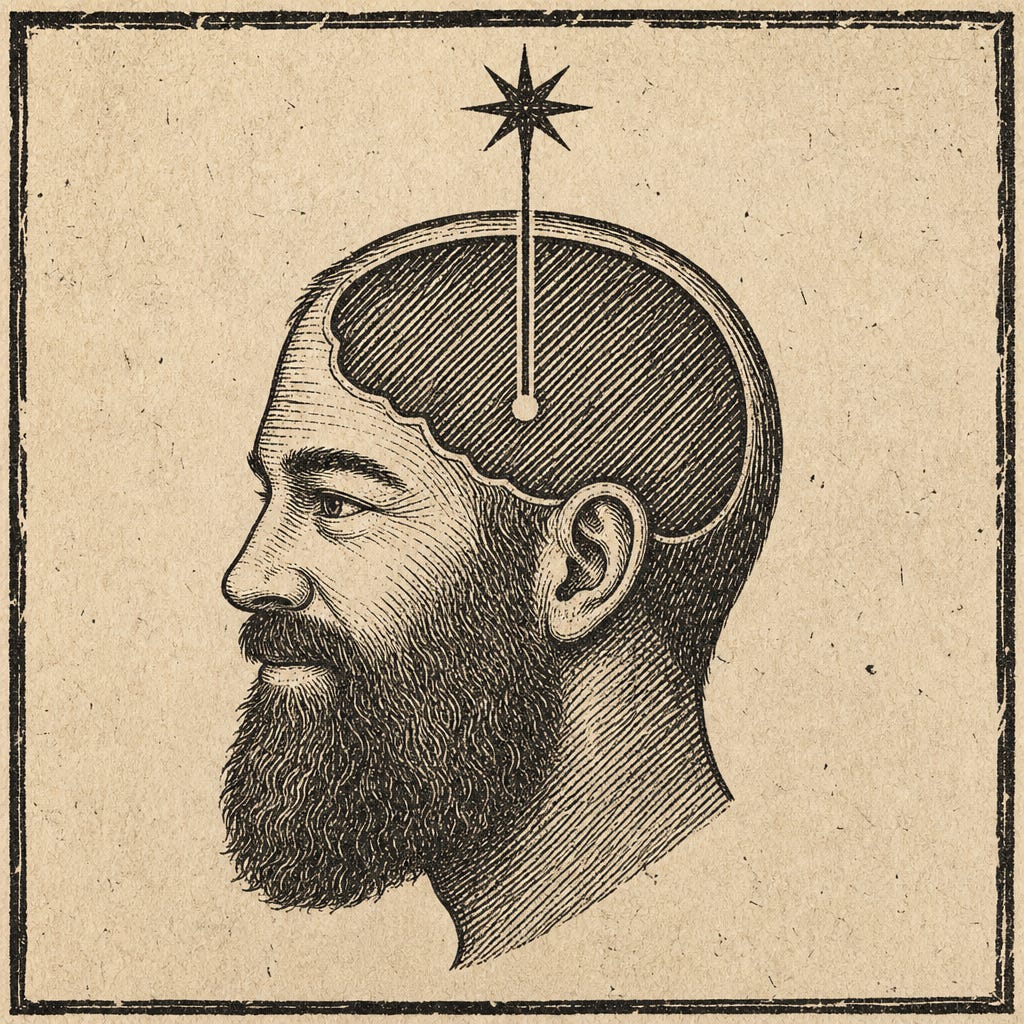
The practitioner in that message is Gil Garza, and the protocol was SMR, sensorimotor rhythm training, at Cz. It was the first protocol I ever ran, ten sessions over three weeks in August of 2025. The clinical notes for early SMR work list transient hyperarousal as an expected effect during titration, which is a tidy clinical phrase for what I was actually doing that week, which was walking around inside a body I had never been able to hear before and dropping things.
Over the following nine months Gil moved me through protocol after protocol, seventy-five sessions across nine of them, each one responding to where my brain was that month rather than following a generic curriculum. Posterior work at P3 and P4 to address the asymmetry. SMR again at C3. Bilateral central training. Frontal work at Fz. Running underneath all of it from late November onward, an eyes-closed alpha-theta protocol at Pz, the deep-relaxation one, sometimes stacked into the same half hour as whatever else I was doing that week.
The protocols were doing something the article’s premise depends on. Each one changed what I was able to feel, and in roughly the order you would want. First the anxiety became a discrete sensation instead of the water I swam in. Then, slowly, the sensation became something I could stay with instead of route around. Then the parasympathetic side started coming online, and I learned what it felt like to actively let go of tension rather than wait for it to leave on its own.
In March of 2026 Gil ran a comparative QEEG against the baseline. The stress markers had moved, which was the good news. The complicated news was what showed up underneath them: a classic ADHD presentation that the original scan had never displayed. Gil’s read was that my brain had been using the stress and hyperarousal pattern to compensate for an underaroused frontal system, and that removing the stress had exposed the architecture it had been covering for.
I had been running anxiety as my executive function. Take away the noise, and what the noise had been standing in for became visible.
Charlotte got there years before the electrodes did. When things get calm and there are not enough real problems, she says, I make some up. I used to hear that as a comment on my character. It was a field observation of my arousal system: when the frontal hardware runs quiet, the rest of me goes looking for something to burn.
That finding produced the last protocol in the sequence, T3 to F3, left temporal to left frontal, which I ran from the middle of April to the middle of June. Eleven sessions. The alpha-theta at Pz finished the same day. Since then I have not been running anything, which means I am writing this about six weeks out from the last session, far enough to tell the difference between an effect that lives on the training day and something that stayed.
Something stayed. Grief and sadness arrive with less intellectual armor. Fear shows up as a body event with tears, instead of as a cognitive thought I’m tracking. Earlier this summer I cried at Click. The Adam Sandler movie. The one where a man fast-forwards through his own life and arrives at the end having missed it. It turns out I cried at it twenty years ago too, back before I had a single word of this language. The movie had been tagging something I could not yet feel. I sit with emotion now rather than reaching for the Cognitive Bodyguard who used to convert every feeling into a framework before it could land.
The architecture underneath that last protocol, and what it did to my capacity to reach toward other people, is its own article. It’s the next one in this series.
The Coach Who Asked the Right Question

While Gil was running the neurofeedback, I was working in parallel with John Syc, my neurocomplexity coach. John’s role is harder to describe than Gil’s. Gil reads electrical activity off my scalp and adjusts protocols. John asks me what I am feeling right now, and waits while I find out. They have been working on the same architecture from opposite directions.
Somewhere in the middle of the work, John said this to me:
You have not learned the language of a non-traumatized somatic emotional voice. And so it comes in now very chaotic, and you haven’t come into contact with how does it speak, how does it guide you.
Notice the construction. He framed it as a language I had not yet learned. The body had been speaking the whole time. I had been listening the way you listen to a language you do not speak, where sounds register as sound but do not yet carry meaning.
Before that, I had described to him a moment from a trip to North Carolina where I felt sadness arrive, gave myself a few minutes to work out why, and let it move through. Months later he named the shift directly: there had been a disconnect with anxiety, and only recently had I started registering it in the body.
He has been teaching me the language. Gil has been changing the conditions under which the language can be learned. The cognitive scaffolding has been the AI and the infrastructure I have been building for two years, which catches what I notice during the work, stores it, and lets me find patterns across sessions when my own working memory will not hold them. None of these three is sufficient alone. Protocol, relational scaffold, and external memory, running at once.
The Aperture Widens in Both Directions
For most of my life, pleasure registered at lower bandwidth than my cognitive recognition of it. I could describe an enjoyable moment with precision. The felt experience of receiving that moment was operating at a different volume than the framing of it. This is hard to notice from the inside, because the framing is so good. The articulation is so clean. The map is so detailed. You can have an entire life in which you accurately observe your own pleasure without entirely feeling it.
The same shift that has let sadness move through me is letting pleasure register at intensities I didn’t have access to before. Not only the peak experiences. The ordinary ones. Hot tub heat at the right temperature. A meal that hits exactly. The first ten minutes of a good cigar on the patio.
I had a preview of this opening from an unexpected direction, too. During an ADHD medication trial, the catecholamine shift widened the range of felt pleasure almost immediately, and it was ultimately too much, because a lack of dopamine generation was never my problem. That trial is a story for another day. What it left me with was proof that the aperture could move at all.
The architecture amplifies across the full valence spectrum. Pain becomes more painful and pleasure becomes more pleasurable, because the gate is opening on both. The 2e literature on overexcitabilities has been describing this for decades. Sensual overexcitability, emotional overexcitability, the whole catalog. What I had not understood, until I was sitting on my patio noticing my own pleasure with a clarity I had never had access to, is that the overexcitabilities had been there all along. The receiving apparatus had been narrow.
The body had been waiting on two things. It was waiting for the conceptual scaffolding to grow rich enough to hold what it would find there, and for the neurological infrastructure to be retrained enough to let the signals through. That wait was the third factor doing what the third factor does: refusing the inadequate version, and building toward a configuration that no inherited material would have produced on its own.
What the Late Arrival Means
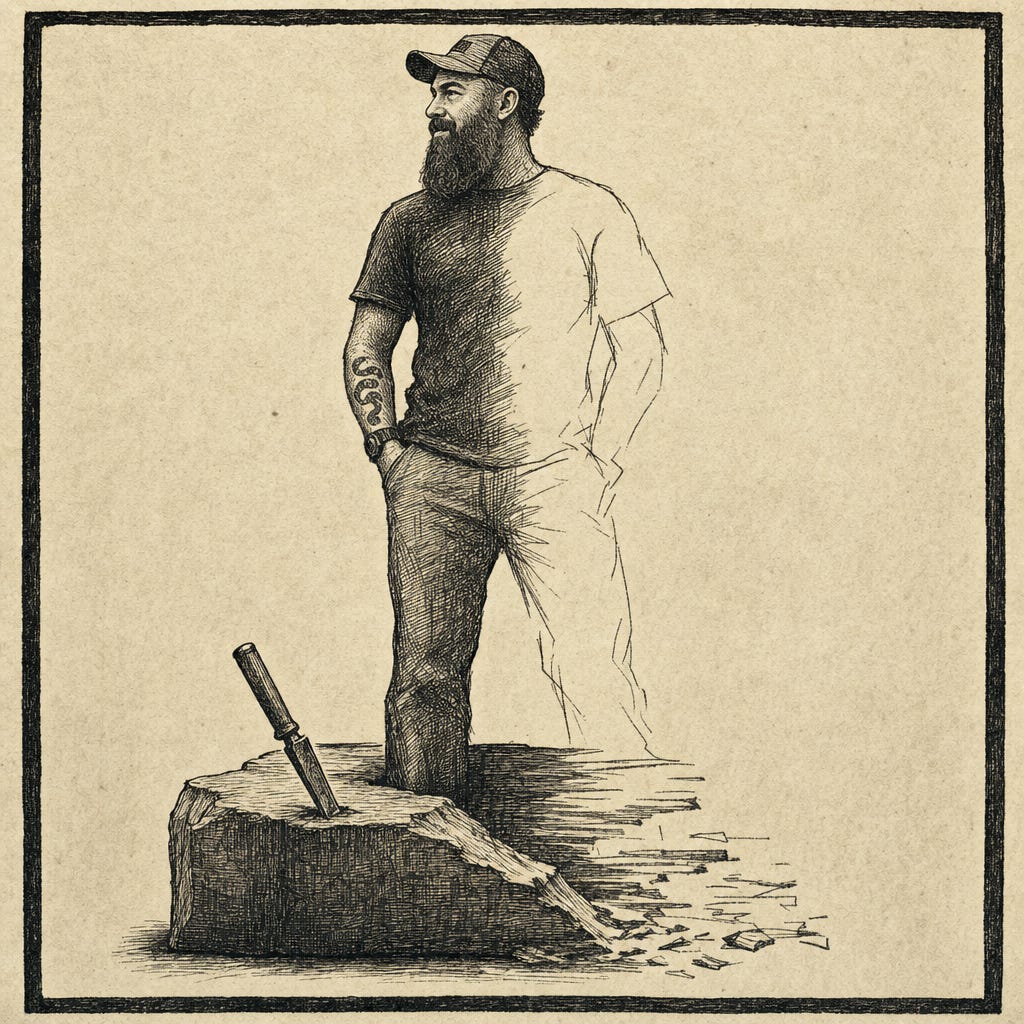
If the spike profile is temporal, and if protracted maturation operates per domain, then a late-arriving capacity in any specific area of life carries a different meaning than the deficit framing assumes. It marks where the third factor is currently planting flags. The areas that hurt, and where you sense the standard explanation is incomplete, are the next sites of construction.
So here is the prediction. If you are a 2e adult, and there are areas of your life where you have been waiting decades to feel competent or whole or fluent or alive, the question is not why you haven’t figured this out by now. The question is what conceptual or relational or neurological infrastructure that domain needs before the third factor can safely operate in it. Sometimes the answer is a framework you have not yet found. Sometimes it is a practitioner you have not yet met. Sometimes it is, in my case, an electrode at T3 and a quiet coach in a quiet room with an unhurried hour every Tuesday.
The body was the last room I had not yet entered. It took protocols and a coach and a year of explicit somatic practice and forty-five years of waiting. When I finally got there, I found that everything I had been theorizing was sitting inside it, waiting to be felt rather than understood. The receiving had been narrow. The receiving is opening.
There is a chair on my patio that I sit in for hours. Last week, while I was sitting in it, sadness moved through me. It arrived with its own weight and shape and duration, and I noticed it land, sat with it, watched it move, watched it leave. The whole thing took maybe four minutes. I did not have to run a test on it, or name three colors, or work out what the sensation was evidence of. It was already legible, and so was I.
A year ago I needed an experiment to tell me what my own chest was doing. Now the reading comes free. Forty-five years, seventy-five sessions, one coach, and a paperback picked up in fifth grade, all so that a small sadness could move through a man in a patio chair and find him at home.
Human. Deeply seen.
Why I write this
Most people get described at low resolution, a stick figure of who they actually are, handed to them by a doctor with nine minutes or a personality quiz or their own worst day. I build the higher-resolution version. It’s called a Life Model: a structured, shame-free read of how your particular mind is built, in a form you can actually use with yourself, your doctors, and the people you love.
If a piece like this lands as recognition and not just an interesting read, that’s usually the signal. Later this year I’m running a small cohort with my wife Charlotte, a trauma-informed yoga therapist, where we build these together. I also do one-on-one builds for people who want the bespoke version.
Neither is open for enrollment yet. What’s open is a conversation. If you want to talk through what you’re working with and whether any of this would help, just reply, or DM me via Substack chat. No pitch.
I have done this faster in 7 days at the Hoffman Process. Came in blank and empty inside. Scared 😱 of my own lack of empathy and feeling. 7 days later came out feeling absolutely fucking everything. And everyone - I could look at the person and feel their anxiety, shame, aversion to connection, curiosity, kindness…from hypo to hyper in 7 days. I felt so intensely - it was unbearable at times. And above all, I felt profound love ❤️ for all human beings. I still remember thinking - 🤔 wow 😮 this is must have been how Jesus Christ and Buddha felt towards people. It subsided and normalised after about 2 weeks. But I will always remember that feeling. It was pure bliss. Like going to heaven alive.
"The body was the last room I had not yet entered. It took protocols and a coach and a year of explicit somatic practice and forty-five years of waiting. When I finally got there, I found that everything I had been theorizing was sitting inside it, waiting to be felt rather than understood." Not me crying?! Breathless here. I don't really have words, but you know I know.