


TL;DR: I used to work 60 hours a week and still miss deadlines. Now I work 7 focused hours across a week and deliver more than my boss needs. Discipline has nothing to do with it. My brain runs on a completely different equation, and I finally understand that. But there’s still a whisper that won’t quit: “Am I allowed to work this way and still be a good person?” Turns out I’ve been asking that question since 3rd grade.
My boss gave me a project this week. Five-day deadline. Important stuff.
Old Jon would have opened his laptop immediately. The one with 15 years of product management and a trail of burnouts behind him. He would have worked 40 hours, maybe 50. Felt stressed the entire time. Delivered something detailed, thorough, over-engineered. And then watched his boss skim it in 30 seconds, say "looks good," and move on without grasping half of what went into it.
New Jon? New Jon is going to spend most of those five days not working on the project.
Before you report me to HR, let me explain.
The Equation Nobody Taught Me

For most of my career, I operated under the neurotypical productivity model:
Time × Effort = Output
More hours. More trying. More output. Simple math, right?
Except it never worked for me. I’d grind for 60 hours and still miss deadlines. I’d white-knuckle through workdays and produce misaligned results. I’d burn out, quit, get “laid off” (we all know what that means), rinse, repeat. My career trajectory looked less like a ladder and more like a pinball machine. Lots of motion, unclear direction.
Except that’s not quite right either. I did climb the ladder. Director of Product Management at Bazaarvoice, leading a team of 40+ and a portfolio worth $500M in revenue. First non-founder product hire at Yonder, building out an entire product organization. $200k+ salaries, strategic influence, the whole package.
The pinball wasn’t about failing to advance. It was about how I got there, what it cost, and how long I could sustain it before the machine tilted.
What I've finally learned is that my brain runs on a different equation entirely. (It took neurofeedback, EMDR, QEEG brain mapping, and frankly a lot of expensive mistakes to get here.)
State Quality × AI Leverage × Focused Sessions = Output
This week’s project will get approximately 7 hours of my direct attention. Maybe 3 hours on Day 2, 4 hours on Day 4. That’s it.
Those hours will happen when my nervous system is regulated, my environment is optimized, and I can access hyperfocus. That state where my 92nd percentile intellect and pattern recognition are actually firing at 100%, without the burnout tax I used to pay for it.
During those 7 hours, I’ll use multiple AI tools as force multipliers. The output will be detailed, thorough, and frankly over-engineered. My boss will probably say it’s “too much” again. I’ll add an executive summary and call it a compromise. Everyone wins.
The other 33 hours? They’re not prep time. They’re not slack. They’re the investment that makes those 7 hours even possible.
The Operating System, Not the App
Here’s the reframe that took me way too long to internalize:
Nervous system regulation isn’t preparation for the “real” work. It IS the work.
For a brain like mine, regulation is the operating system. High intellect, zero orderliness (that's not hyperbole; it's the actual percentile from my Big Five assessment), anxious attachment, sensory processing that runs hotter than most. Everything else runs on top of it.
Without a regulated nervous system, I can’t access my actual capacity. I'm spinning cycles, reconstructing context, managing overwhelm. Running at a fraction of what's possible. With regulation, I’m genuinely exceptional at what I do. It’s not arrogance; it’s data.
So what do those other 33 hours look like?
Going for a ruck. Sitting in the hot tub. Taking a nap when my body says to (okay, sometimes when my body screams it). Working on jonmick.ai when that energy is lit up. Doing a household chore my brain suddenly wants to complete. Charlotte finds this either endearing or baffling, depending on the day. Cold plunge. Following whatever thread is actually available in the moment.
This isn’t “33 hours of prep for 7 hours of work.”
This is a life where work is one energy channel among many, and I route myself toward whatever channel is actually available.
Rucking isn't "preparing to work." It's living. Jonmick.ai isn't procrastination from the day job. It's following the thread that's actually charged. The chores, the cold plunge, the hot tub. Those aren't earning the right to eventually be productive.
They’re part of the whole system functioning.
The Code Club

This pattern didn't start in my career. It started in 3rd grade. I only just realized that last week.
I was in the gifted class. Seven of us, combined in a classroom with three gifted 4th graders. Mr. Galloway (RIP) ran the room, but we didn’t need much instruction. We could read the math assignment, complete the classwork in 15 minutes, and have roughly an hour of “free time” before the next subject.
Most teachers would have filled that hour with busywork. More worksheets. “Enrichment activities” that were really just more of the same. Mr. Galloway let us self-govern.
So we built a Code Club.
We invented a new language, both writing and speaking, and held code-breaking competitions against each other. Just the seven 3rd-graders. The 4th graders sharing our classroom weren’t allowed. This was ours.
I’m only seeing it now, writing this: the Code Club wasn’t really about cryptography. It was survival infrastructure.
The worst part of being in the gifted class wasn't the work. I loved the work. It was recess. We had to go to lunch and recess with the 4th graders, who went with grades 4-6. My friends, the ones in the "regular" 3rd grade classrooms, went with grades 1-3.
We were definitely the odd ones out. Eight-year-olds surrounded by eleven-year-olds who didn’t understand why we were there. Who looked at us like we didn’t belong. Because, socially, we didn’t.
The Code Club gave us something to be. A shared language. A culture that was ours. Something the big kids couldn’t penetrate or mock because they couldn’t understand it.
We were building protection; not just filling time.
The Choice I Made at Nine

After 3rd grade ended, I left the gifted program.
I remember telling my parents: I want to be with my friends. I want to learn how to be with the normal kids. There are more of those people.
I haven’t thought about that decision in decades.
At nine years old, I did the math. The gifted classroom gave me efficiency, intellectual peers, and free time for self-directed projects. But it cost me my friends. It displaced me socially. It made me other in ways that required building secret languages just to survive recess.
So I chose belonging over optimization.
I walked away from the environment where my brain worked best. The place where I could finish the required work and then do what actually interested me. The social cost was too high.
And then I spent the next 35 years trying to fit into “normal” environments that weren’t built for how I actually work. Trying to grind 40 hours when I could deliver in 7. Performing presence. Pretending the way I operate is the way everyone operates.
Was the 9-year-old wrong? I don’t think so. He made a rational choice: There are more normal people. I need to learn to be with them.
But the 44-year-old is finally asking a different question: What if I could work the way I actually work AND still belong?
Finding My People (And Burning Out Anyway)
My first full-time job out of college was with Deloitte Consulting.
For the first time since 3rd grade, I was surrounded by my kind. Smart, hard-working people who actually wanted to solve problems. Who got excited about frameworks and edge cases and elegant solutions. I excelled. I traveled constantly. I met amazing people. It was the best time in my career.
It was also completely unsustainable.
Our annual performance was based on two things: utilization and special projects.
Utilization was the percentage of your 40-hour workweek billed to clients. As a new consultant, you aimed for 70-90%. I averaged 108%.
That wasn’t enough to stand out.
We were also evaluated on special projects. Non-billable work that demonstrated commitment. Proposals. Volunteer events. Internal tech solutions. Leadership visibility. The stuff that showed you were a “culture fit” and “going places.”
Read that again: I was billing more hours than exist in a workweek and still needed to do additional unpaid work to be seen as a high performer.
This was the intersection of neurotypical productivity expectations with gifted-kid perfectionism. The system demanded both. Grind the hours AND show extra initiative. Be fully utilized AND contribute beyond your utilization. Do the work AND prove you belong with the big kids.
Sound familiar? It was the recess problem all over again. Just with business casual and expense reports.
I survived for five years.
Then I quit on my son’s first birthday.
I remember the clarity of that moment: I need to get my time back. I need to get my life back. Jack was turning one, and I’d spent his first year on planes and in client conference rooms, billing every hour I had and then some. Missing bedtimes. Missing mornings. Missing him.
I took a job at a design agency in Austin. Their first Program Manager. Local. Minimal travel. No expectations of special projects.
Still billable, though. Four more years of tracking every hour. Four more years of the clock always running.
I'm realizing now, writing this, that the first eight years of my career were billed, or expected to be billed, every single hour.
No wonder I didn’t know another way was possible.
The 60-Hour Ghost
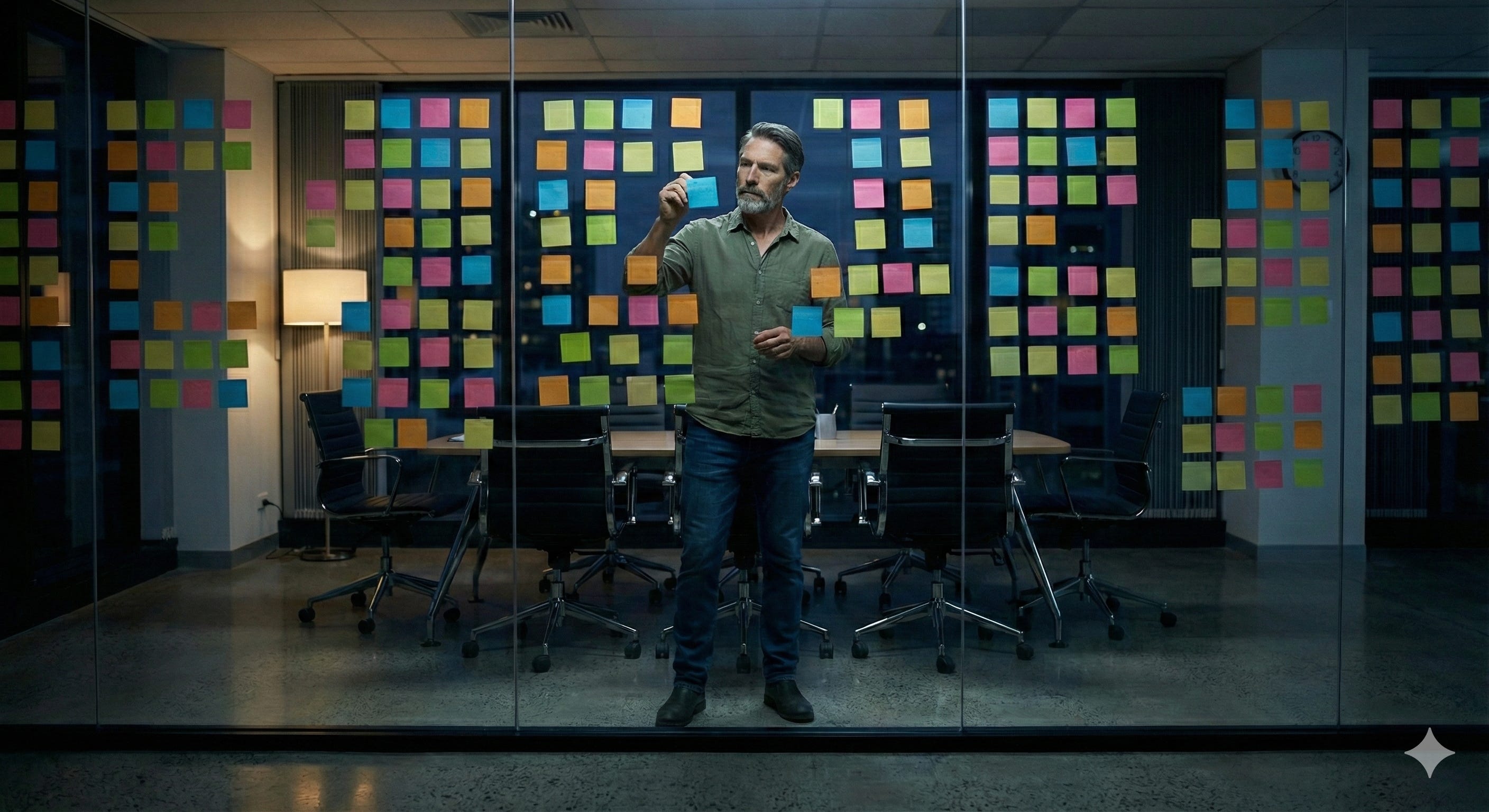
Later in my career, after Austin, after a few more job changes, I routinely worked 60 hours a week. I’d stay until midnight because that’s when the office finally got quiet enough for my brain to do what it actually does. I’d fill conference rooms with Post-Its at 7 PM, mapping constellations of ideas without anyone kicking me out for their scheduled meeting.
I thought that version of me was “good.” Dedicated. Hardworking. A real grinder.
Every single time, here’s what happened to that guy though. He’d impress people early. Gain attention, gain projects, gain trust. Leadership would reallocate resources elsewhere because “Jon can get it done.” The workload would compound. And then he'd burn out. Not just unable to keep up, but no longer wanting to keep up. The thing that made him valuable became the thing that crushed him.
Multiply that cycle a few times across a career, and you’ll understand why I’m looking for another way.
The 60-hour version wasn’t sustainable. He wasn’t virtuous. He was surviving.
He was also chasing the exact same thing I'm chasing now: the conditions for his best thinking. He just didn’t have:
Language for what was happening (working memory fragility, state-dependent cognition, hyperfocus as a design target)
Permission to structure the day around it deliberately
AI tools to multiply the output
The meta-awareness that midnight flow wasn't random. It was a predictable pattern he could design for instead of stumble into
The guy filling conference rooms with Post-Its at 7 PM and the guy scheduling 7-hour deep work sessions across a week?
Same guy. Fifteen years of self-knowledge and better tools.
He wasn’t broken then. He was unoptimized.
The Pattern That Never Changed
I’ve been doing this my whole life:
Complete the required work efficiently → Use the freed capacity for what actually matters.
In 3rd grade, it was cryptography and cultural survival.
At Deloitte, it was... wait, there was no freed capacity. That’s why I burned out.
Now, it’s nervous system regulation and building AIs & Shine.
The pattern isn’t laziness. It’s not “getting away with something.” It’s what happens when a brain like mine is given the space to operate according to its actual architecture.
Mr. Galloway understood something most managers don’t: if the work is done and done well, the remaining time belongs to the person who earned it.
The neurotypical model says: If you finished early, you didn’t work hard enough. Here’s more busywork.
Mr. Galloway’s model said: You finished? Good. Now do something interesting.
Deloitte’s model said: You finished? Good. Now do special projects. And bill more hours. And travel more. And—
I’ve spent 35 years trying to find workplaces that operate like Mr. Galloway’s classroom. Mostly, I’ve failed. So now I’m building one.
Procrastination Is Just a Gap
While we're burning down paradigms (Dabrowski would call this positive disintegration, the necessary collapse of old structures before better ones can form), let's talk about procrastination.
The neurotypical model says procrastination is avoidance. Laziness. A character flaw to be overcome with willpower and productivity hacks. As if I just haven't tried the right app yet.
For me, procrastination is the gap between context activation (boss gives me a deadline) and state readiness (nervous system regulated, environment optimized, hyperfocus accessible).
I’m not avoiding the work. I’m waiting for activation + state alignment. The “procrastination” IS the gap.
And I’m not trying to eliminate it through willpower. I’m trying to shorten it through regulation and environment design.
Some days the gap is 20 minutes. Some days it’s 48 hours. And some days, if I'm being honest, it doesn't close until the deadline gets close enough to tip the scales. The urgency finally makes the task loud enough to break through my fragile working memory and hold context. That’s not a character flaw either. That’s just how salience works in a brain like mine.
The old me would have spent those 48 hours in self-flagellating "work." Grinding, hating himself, stress-producing something detailed that would get skimmed in 30 seconds anyway. The new me spends them regulating, trusting that the window will open, and then delivers the whole thing in one 4-hour burst.
Same output. Less suffering. More life.
The Whisper That Won’t Quit
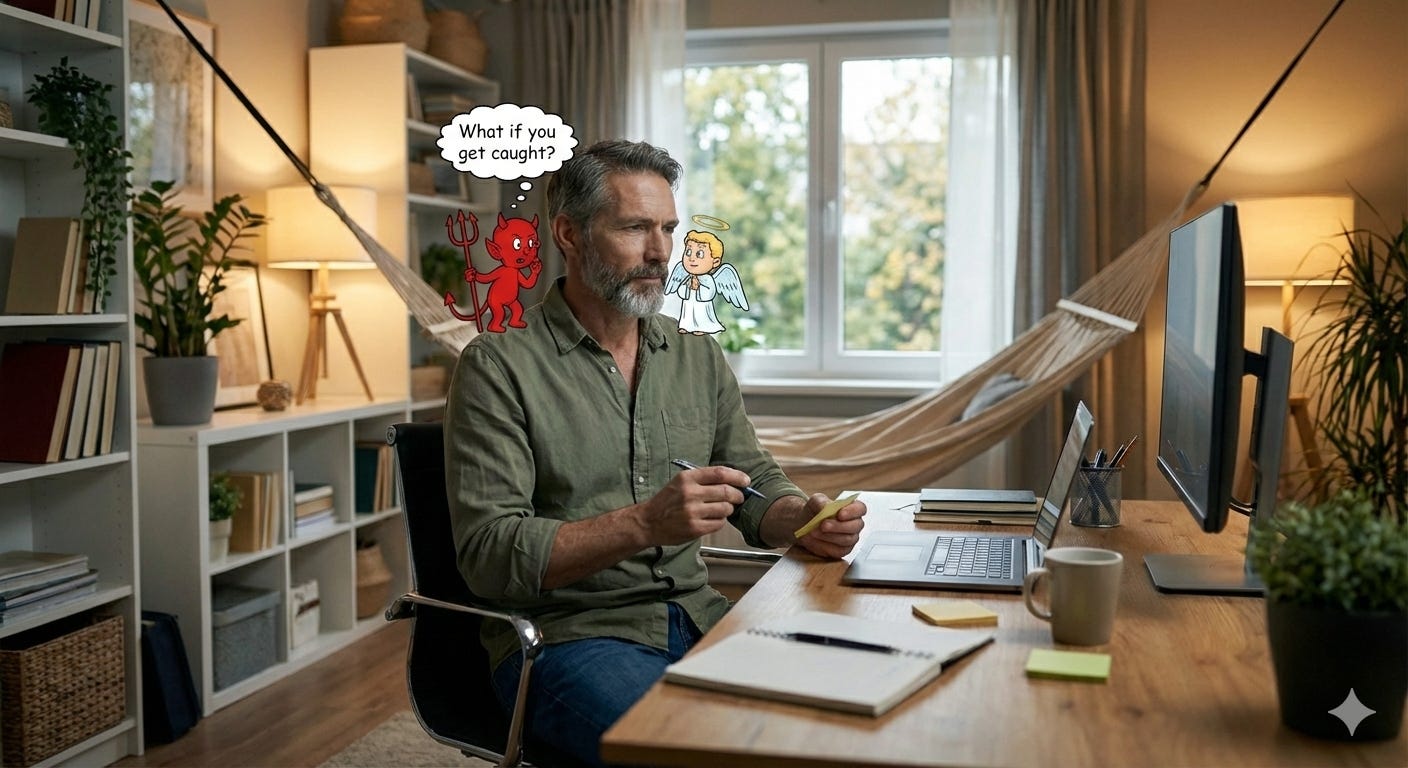
I’ll be honest. There’s still a whisper in the back of my head:
“You’re getting away with something.”
“What if you get caught?”
“Are you cheating your employer?”
I've sat with this. In therapy, in the hot tub, in 2 AM conversations with Claude. Here's what I've realized: that whisper isn’t about violating an actual agreement.
I’m available when needed. I deliver quality work that my boss considers too thorough. I operate within the explicit flexibility I’ve been given. The contract, stated and implied, is being honored.
The whisper isn’t about cheating my employer.
It’s about violating an internalized norm about what work should look like. The 40-hour grind as moral performance. Effort as virtue, regardless of output. Presence as proof of worth.
Which means the real question the whisper is asking isn’t “Am I cheating my employer?”
It’s: “Am I allowed to work this way and still be a good person?”
I’ve been asking some version of that question since I was nine years old, telling my parents I wanted to learn to be with the normal kids.
The Loneliness of the Invisible Model
Here’s what I haven’t figured out: this model only exists visibly to me, Charlotte, and my AI collaborators.
To my colleagues, I’m still doing the 40-hour grind. It's a "Don't Ask, Don't Tell" culture. As long as I'm available on Teams and delivering results, nobody's looking closely. Nobody’s asking how the sausage gets made.
But there’s a loneliness in that. I’ve figured out something real about how I work, and I’m performing a fiction to maintain social cover.
Just like leaving the gifted program. Choosing to look “normal” even when normal doesn’t fit.
Part of why I write here is to find people who read this and think: “Oh. That’s not cheating. That’s how I work too.”
Because I don’t think the whisper quiets through more internal validation. I don’t think I can self-help my way to peace with this. I think the whisper quiets when this way of being has witnesses who get it.
Maybe you’re one of them.
The Permission Slip
So here's what I'm writing myself permission for. Maybe you need to hear it too.
You’re allowed to work differently and still be a good person.
If you deliver quality work, honor your agreements, and show up when needed, the how is allowed to be yours.
If nervous system regulation takes 33 hours to enable 7 hours of genius, that's not cheating. That's architecture.
If you follow your energy into rucks and hot tubs and naps and side projects, that's not avoiding work. That’s living a life where work is one channel among many.
The 60-hour grinder wasn’t more virtuous. He was unoptimized, white-knuckling it, outworking his own chaos because he didn’t trust that his actual contribution would be enough.
The 9-year-old who left the gifted program wasn’t wrong to want belonging. But he didn’t have to choose. He just didn’t know another way was possible.
You’re allowed to trust it now.
You're allowed to build the Code Club again. This time without having to hide it.
Mr. Galloway would understand. And if you’ve read this far, maybe you do too.
Human. Deeply seen.
Jon Mick is the founder of AIs & Shine, building AI-powered cognitive scaffolding for minds that work differently. He’s currently “working” on a project due Friday, which means he’ll probably be in the hot tub for the next two days. The output will still be over-engineered.
I felt very seen in this article. Thanks for the permission. It has been over 40 years, and it's about time I stop fighting my own neural architecture to fit in.
Force-fitting in never worked for me anyway.
Everything you describe, has parallels in how I understand myself. Different paths, same conclusions.
My brother was labeled gifted and diagnosed with ADHD, as a child. From a young age, I did math workbooks for fun and couldn't get enough, yet was missed. I grew up being told & believing I was "stupid", an "airhead", not as bright as my brother. Later in life, I learned that I'm AuDHD. Learning to accommodate myself in a neuroaffirming way has unlocked my brain in ways that regularly shock me. Who knew I'm actually intelligent! 🤪
To have access to my "supernova days", I need to offload unnecessary cognitive load, to deconstruct or replace norms, to regulate & exist differently than common "shoulds & oughts". I wish others knew it's not only okay but necessary to challenge the norms. Thank you for "seeing" me, for allowing me to "see" you, and hopefully the shared witnessing frees others, too. 🙌🏻