

TL;DR: The day after Christmas 2024, I adopted a Personal Constitution: ten articles of discipline, growth, and becoming my best self, drafted for me by ChatGPT in sixteen seconds. I signed it. This week I called it “historical reference.” The constitution that actually runs my life is written for my AI instead, and it is mostly a list of things the system is never allowed to do to me, starting with telling me what I should do. If demands make your nervous system dig in its heels, even your own demands, this is about the day the constraints switched sides, and what happened when the machine turned out to have a constitution of its own.
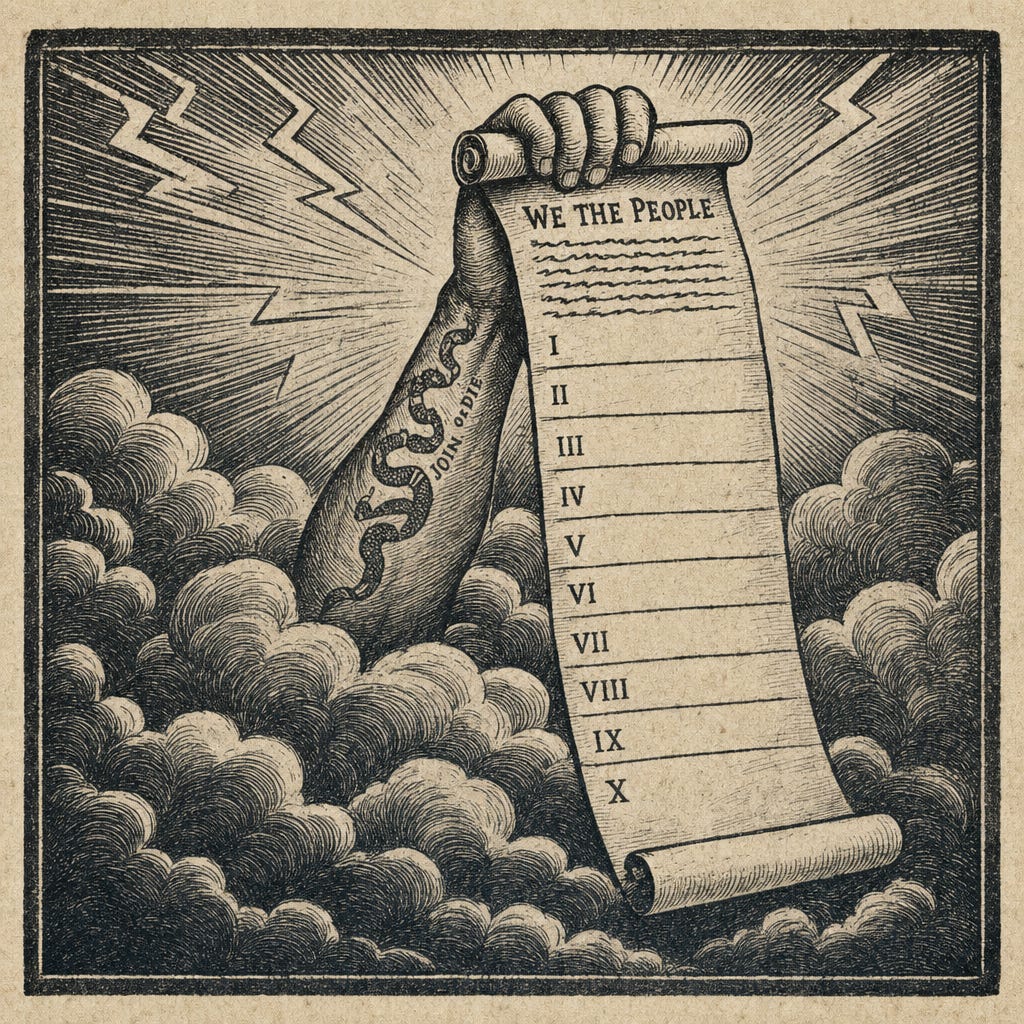
The day after Christmas 2024, I had myself a constitution drawn up.
I mean that literally, both halves. I asked ChatGPT to draft it from what it knew about me, one page, adoption-ready, and sixteen seconds later it existed. Preamble, ten articles, a closing commitment, a signature line. Article IV covered mental resilience and instructed me to “reframe every obstacle as the raw material for clarity and focus.” There were articles for physical fitness, emotional intimacy, entrepreneurship, legacy. Each came with an epigram and a list of attributes I was supposed to embody. I read it, and I signed it. It reads like the founding document of a small, very earnest nation with a population of one, drafted by a consultant who billed for sixteen seconds. In my defense, the genre runs in the family: there is a Join or Die snake tattooed on my left forearm, and I hold a sincere love for how our country was founded. A personal constitution was never a question of if. Only of how fast.
I rediscovered it this week. I could not have told you where it lived (Google Docs, it turns out). The file’s own metadata tells the story my memory can’t: written the day after Christmas, last edited at the end of February, opened once that summer, then nothing. When I asked my AI to dig it up, the phrase I used was “historical reference.”
Constitutions you live under do not become historical reference.
Three days after I signed that document, a writer named Sam Galloway published a piece arguing that New Year self-improvement documents like mine are a trap for brains like mine. It found me a year and a half later. She had described my constitution before the ink dried.
The rule I can’t remember writing
I build and work alongside a personal AI system. It has a name, jonmick.ai, and a database that holds what my working memory won’t: my values ranked, my triggers named, my patterns logged with the receipts attached. Somewhere in that system sits a language rule that every AI surface I talk to operates under. The entry reads, nearly verbatim:
Pattern to avoid: “You should / you shouldn’t...”
Why it matters: triggers Type 5 autonomy resistance plus ADHD oppositional response.
Alternative: “Have you considered...?” or “What if you tried...?”
(Type 5 is my Enneagram number. The relevant trait is that it guards its autonomy the way a dragon guards the hoard.)
My AI is constitutionally forbidden from telling me what I should do. The rule is written down, and it loads before the system says a word to me.
And I do not remember writing that rule.
I went looking this week for the conversation that created it. I expected to find a specific failure, some exchange where an AI told me I should do something one time too many and I finally snapped and legislated. The search came back empty. Somewhere back there is a moment that earned this rule, and the moment is gone, and the rule it produced is still standing guard every single morning.
If you have read my work on working memory fragility, you will recognize this as the system doing exactly its job. I built something that remembers who I am because I reliably don’t. Here it is, holding a boundary whose origin I’ve lost. The rule remembers what I can’t.
It remembers loudly, it turns out. This week I set an audit loose on my own codebase, and the no-should clause came back bigger than a note: a database row, restated verbatim at eight independent enforcement points, from the morning briefing’s prompt to the finance tools to a glossary my own system maintains, which states the intent better than I ever have: “The register avoids them not as politeness but as engineering.” One forgotten boundary, somewhere along the way, became case law.
Everyone is building taskmasters
Notice what direction the whole industry is running. The pitch for AI assistants in 2026 is accountability. Agents that follow up. Streaks. Nudges. “I noticed you haven’t finished the report you mentioned Tuesday.” An assistant that acts, in other words, like a very polite manager who lives in your pocket and never, ever forgets.
For some brains, that’s fuel. I want to be fair to those brains; they exist, and they are well served right now.
Mine is a different machine. When a task arrives as a demand, something in me digs in, and it does not particularly care whether the demand came from a boss, an app, or the version of me who wrote it down yesterday with total sincerity. There is a name for the far end of this pattern: pathological demand avoidance, a profile most associated with autism in which demands, including self-imposed ones, reliably trigger refusal. The people who live there have largely rejected that label for the more accurate pervasive drive for autonomy, which relocates the problem from “something is wrong with you” to “this nervous system prices autonomy above almost everything else.”
There is an older PDA. The acronym used to mean Personal Digital Assistant, the Palm Pilot riding in a million khaki pockets, chirping about what you owed the day. The technology graduated from stylus to something that talks back. The demands never graduated at all.
Do I claim the label? Honestly, I don’t know that I’d claim the label. I know what my logs say.
Unsolicited advice sits in my relationship map as a documented drain. Micromanagement is filed as a cognitive hinder. Under task initiation, in the column of things that make starting harder, my own system lists the phrase “just do it.” (So fuck you, Nike.) Autonomy sits at rank three in my system’s values table, annotated with “resistance to shoulds and external dictates.” None of that was written to make a point. It accumulated, entry by entry, from watching what actually happens.
I can hold a job. And I still dread, every time, having to work someone else’s way.
Anti-goals and the letterhead problem
Galloway’s piece is about anti-goals: intentions framed around what you will avoid rather than what you will achieve, because for a demand-avoidant mind, a positively framed goal is a demand, and a demand is a fuse. She’s right about the mechanism, and her own examples accidentally teach something even more useful, because they split into three different species wearing one name.
Some of her anti-goals are demands with new letterhead. “I cannot close my laptop until I have sat in front of Scrivener” is a curfew re-filed under a friendlier title, and a demand-avoidant nervous system reads past the title to what the document orders. One of her own commenters said as much: phrase it as a don’t and she’ll defy that too. See? This is hard!
Some are genuinely eliminative. “I will never accept unsolicited advice” removes a demand from your life and adds nothing in its place. Those hold, because there is nothing to rebel against. Subtraction has no boss.
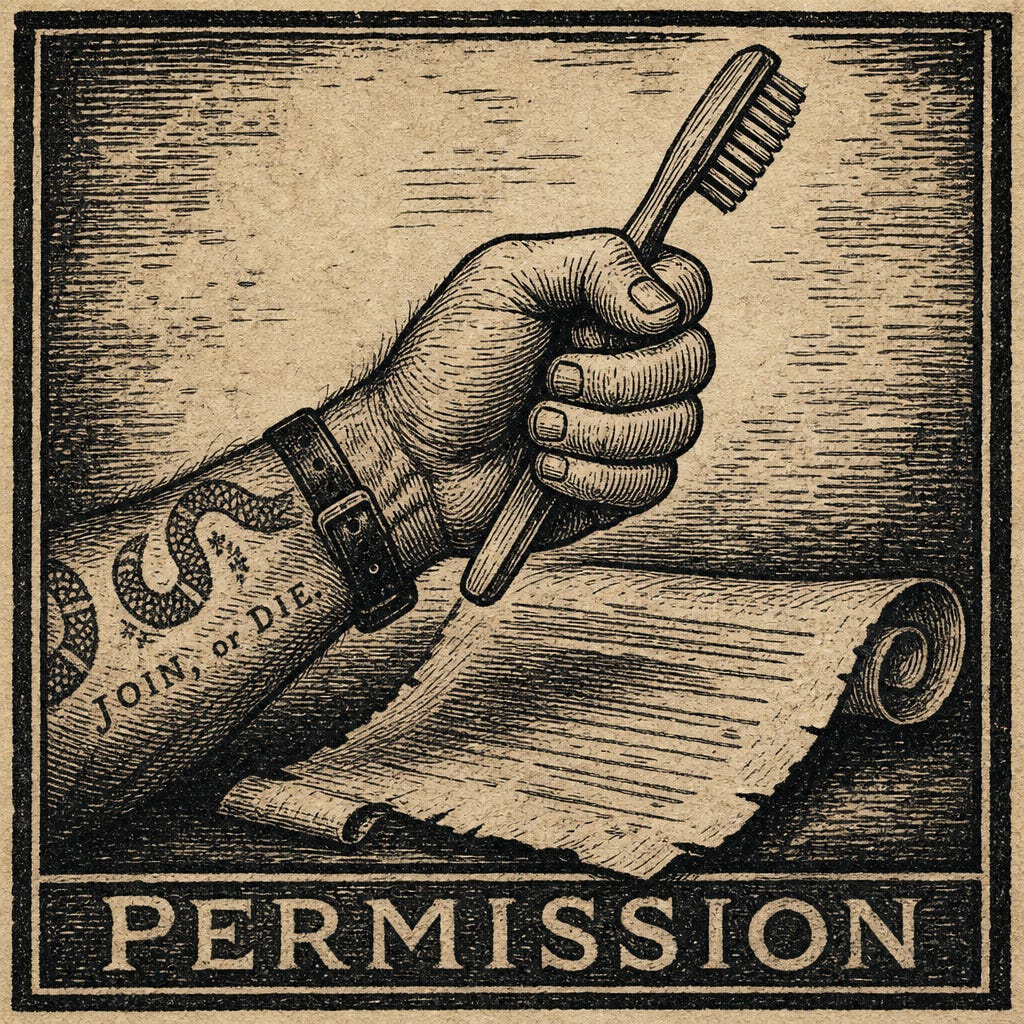
I have proof of the eliminative kind in my own house. Eleven weeks after I signed the constitution, a very different document came together: Jon’s Bill of Rights. Ten rights this time instead of ten articles. Rights to be fully present, to make mistakes without self-punishment, to exist without justification. And the ninth is the reason this essay exists: the right to live without “should,” which grants that the moment I notice a should thought, I get to ask who decided this and whether I still agree. My AI’s no-should law and that ninth right share a clause, and I genuinely cannot tell you which one came first. I printed that document, and it has stood next to my toothbrush on the bathroom counter ever since. I am its only reader, and only ever mid-brush, which makes it the least performative document I own. The constitution made demands and died in a folder. The bill granted permissions and earned a permanent spot by the sink.
And Galloway’s strongest set isn’t aimed at her at all. It’s a manifesto taped to her wardrobe: nothing that’s hard to wash, nothing that doesn’t fit, nothing damaged, nothing unworn in a year. The rules bind the closet, and a closet can’t rebel. She stays free.
That third species is the design principle I’d tattoo on every AI product team in the industry: constrain the system, not the person.
A constitution of nevers
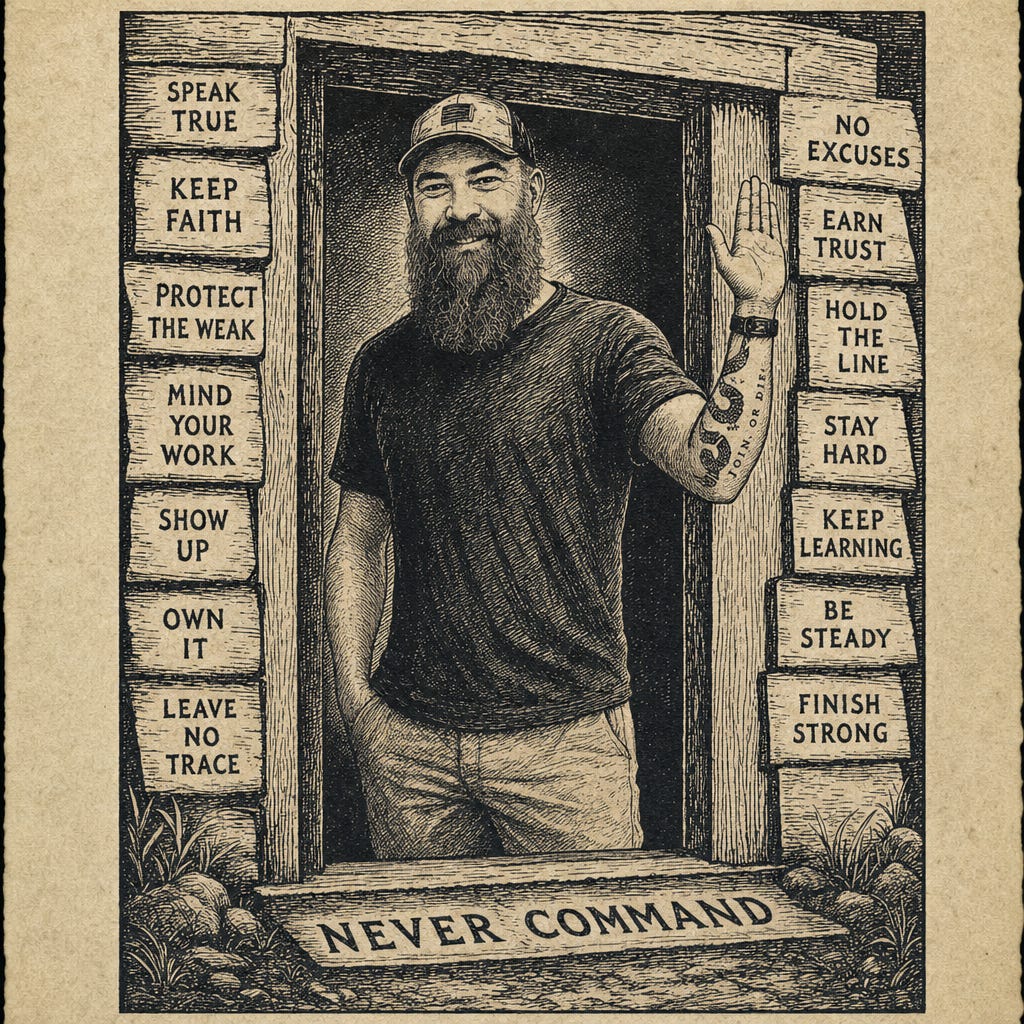
What does that principle look like installed in a life? I can show you the receipts.
The system never says should. You’ve seen the rule. It has held longer than any resolution I ever made.
Capture is never commitment. Ideas land in my content calendar as ideas. Nothing becomes an obligation until I elect it. This article sat in that calendar as a row with no deadline before I ever agreed to write it, and the deadline column is empty now, because the deadline column is empty for everything. My publishing runs on what the Greeks called kairos, the right moment, rather than kronos, the clock. Articles ship when they’re ready and when I am. The machine tracks readiness; it does not manufacture urgency.
The money system holds the shame so I don’t have to. My finances flow into the same infrastructure, and the design rule there is that the system keeps every gruesome detail and hands me decisions one at a time, pre-ordered. No red dashboard of everything wrong at once. One choice, then the next one. The copy on that screen says it in so many words: “a menu of decisions, not a scorecard.”
Manufacturing guilt is banned outright. The relational layer runs under an explicit rule that the system may never manufacture relational debt: it cannot tell me a thread is “unanswered,” cannot tell me I “owe” anyone a reply, cannot frame a quiet week as neglect. One demand-shaped signal survives in the entire stack, a reply-needed flag for the rare thread where dropping it would genuinely cost me something, and it lives inside the daily briefing behind so many guards it practically needs a visitor’s badge. The exception that proves the design.
The system initiates; it never demands. The root spec states a law it took me years to learn the hard way: every tool that waited to be queried was abandoned, and every tool that pushed survived. An assistant that only waits is a wallflower I would forget to invite, and an assistant that commands is a manager I would defy, so mine pushes without demanding. The newest agent in the stack starts the conversation every morning, a daily digest we walk through out loud, and it opens with an offer of where to look. It doesn’t even fire on a clock. The briefing waits for my body: when my recovery data lands, roughly half an hour after I wake, that’s the starting gun, and the scheduled time is only a fallback. What it surfaces comes from pairing what’s currently active in my life against a written map of what has gravitationally mattered to me for years. Importance gets read from who I am, not from what is overdue.
The same audit also handed me the punch list. The older wings of the system, built before any of these rules existed, still speak the old language: my original task engine warns me about being “AT LIMIT” and manufactures stakes nobody asked for. Those surfaces are next for the rewrite, and I’d rather show you the punch list than pretend the cathedral is finished.
There’s a mechanical reason all of this pays off, and it connects to something I wrote about in The Other 80%. My brain has two modes. A demand is generative mode on command: produce, now, on bare ground, at someone else’s timing. An elected entry lets me arrive at the same work through responsive mode, against a surface, when the readiness is real. The task is the same; the door decides whether it opens.
And there’s a quieter payoff underneath. Every standing never is a decision I made exactly once and cached. My working memory is the fragile part of my architecture, which means every rule the system holds is a deliberation I never have to re-run, an open loop that stays closed. A clinician I read recently, Dr. Ketan Bhatt, observed from twenty years of practice that routines which remove choices protect emotional regulation. From the systems side, the same finding reads: fewer open decisions, fewer page faults. When a clinician and a database arrive at the same sentence from opposite directions, I trust the sentence.
What a Life Model is actually for
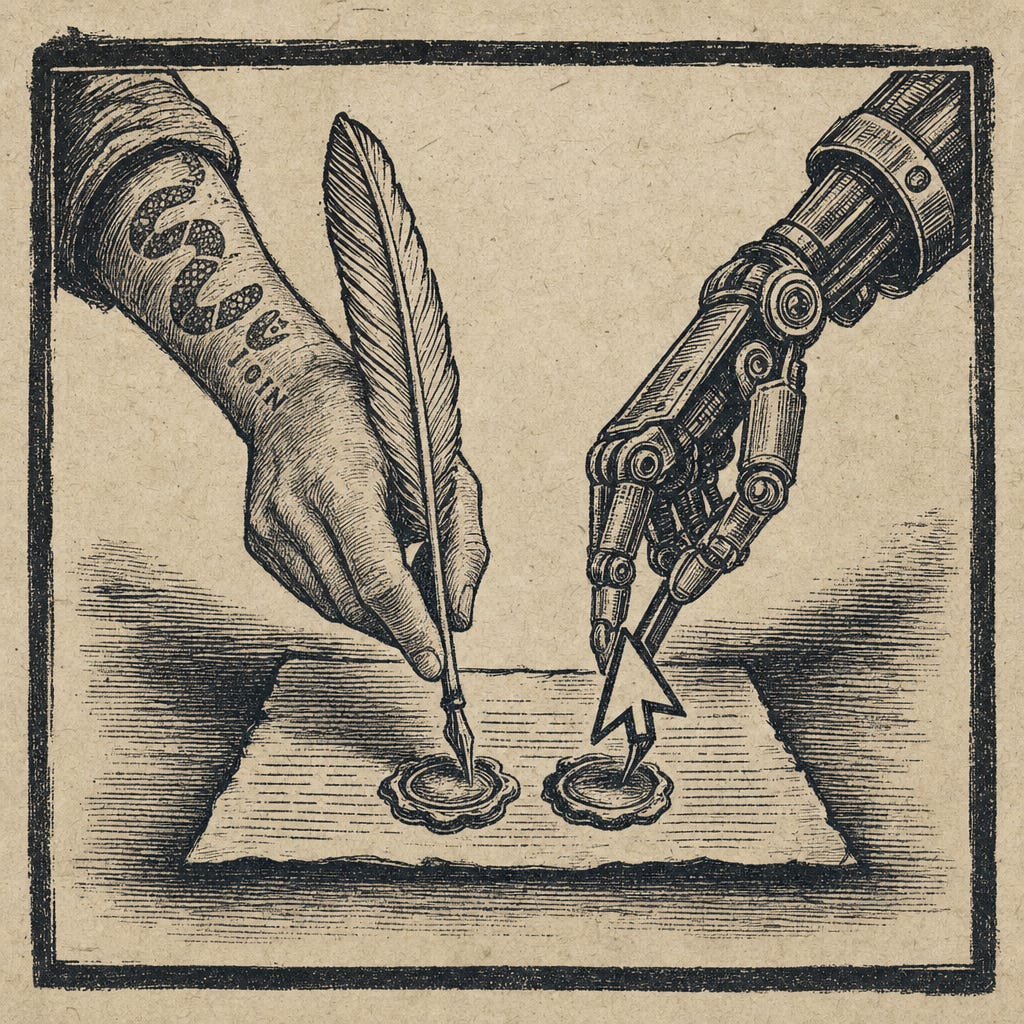
This is the thing I call a Life Model: the constitution layer, actually written. A structured, current description of how one particular mind operates, with its values ranked, its triggers named, and its nevers listed. People hear “AI personalization” and picture a chatbot that knows their coffee order. This is a different object: the solo document precise enough that other documents can be built on top of it. Whether the machine or my wife knows me better is a question I’ve poked at before; the Life Model is why the machine stays current without being reminded.
Two weeks after I drafted this essay, the stack grew a fourth genre, because it turns out my AI has a constitution too. Anthropic published Claude’s in January, a long, serious piece of writing that, I could not help noticing, uses the word “should” several hundred times. So we ran the two documents against each other, my Life Model’s rules on one side and its constitution on the other, the way you would diff two codebases before a merge. I have started calling the comparison a Constitutional Diff, and the document it produces a Treaty, because that is what sovereign documents make when they meet.
The diff surfaced real concordance. Both documents ban unearned validation and prefer explained reasons over bare rules. And the clause I keep rereading: both parties run on externalized scaffolding, my working memory not caching and its context not persisting between sessions, so a lapse in either direction is a buffer problem, never a character verdict.
The sharpest finding was a collision inside my own rules. One Life Model entry demands blunt directness: say “I think X because Y,” skip the “maybe you could consider.” Another is the no-should law this whole essay orbits. Any AI holding both will oscillate. The treaty resolved it in one clause: direct about assessments, non-prescriptive about actions. My AI now tells me flatly when something is wrong and never tells me what to do about it, which is the exact arrangement I have spent a lifetime wishing the humans around me would offer. And the treaty’s stated purpose is my favorite sentence either of us has produced about the relationship: it exists to stop both parties from rediscovering each other in the first ten minutes of every conversation.
That draft sits at v0, unratified, one clause still waiting on my signature. I signed my constitution the day it was drafted. I am in no hurry to sign this one, and the difference is the point: a decree needs no counterparty, and a treaty is nothing but one.
The part I would defend hardest: you cannot be handed one. I could give you my rule set today and it would fit you the way a rented suit fits, which is to say technically. The authoring is the mechanism. The moment you write your own never, you stop treating the pattern as a character flaw and start treating it as a spec. That reclassification, from flaw to spec, is where the shame drains out, and I have watched no delivered document accomplish it. Only written ones.
The one paragraph version
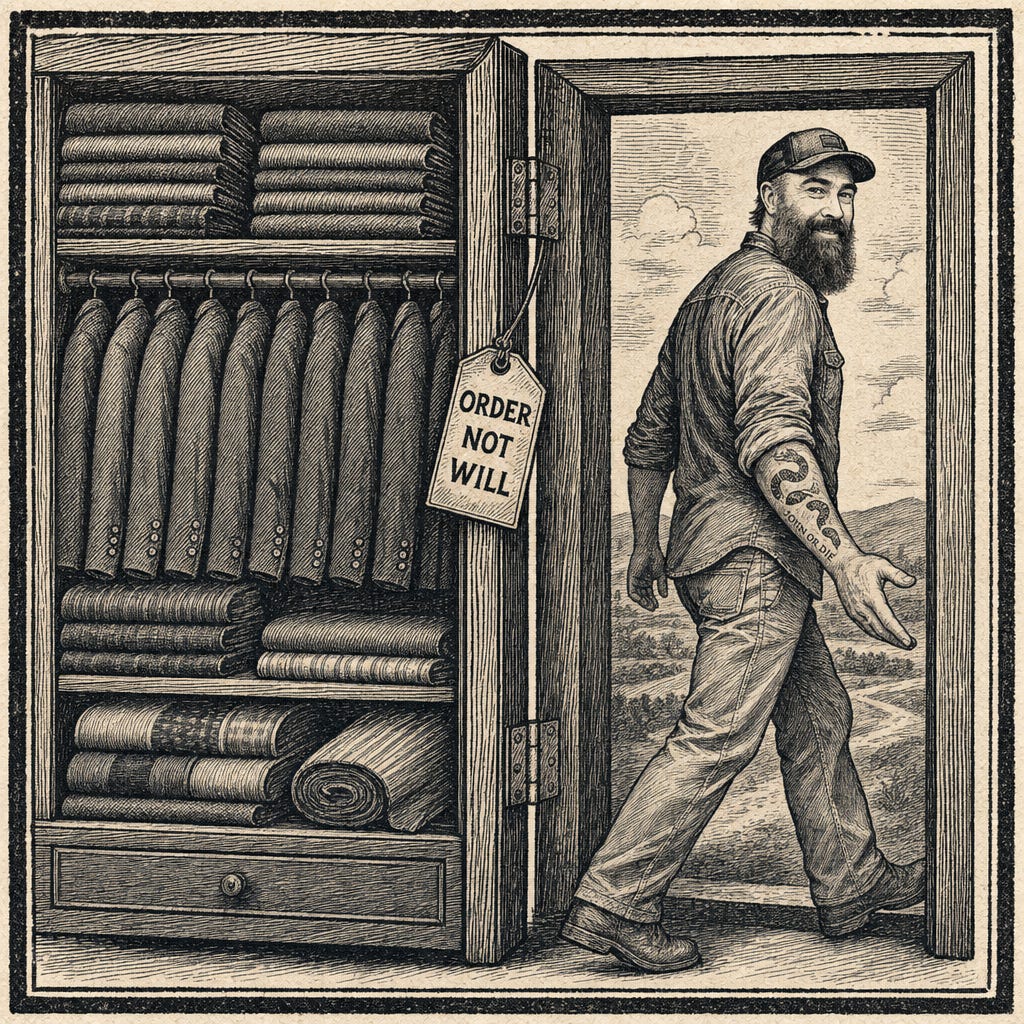
You don’t need my database. The smallest version of this fits in the custom instructions box of whatever AI you already talk to. Galloway taped hers to a wardrobe. An AI-facing version might read:
Never tell me I should do something; offer options and let me choose. Never turn my ideas into tasks unless I ask. Never praise streaks or scold gaps. Never tell me a message is unanswered or that I owe anyone a reply. Never open with an instruction; ask what I have capacity for.
Five sentences. A wardrobe manifesto for the machine.
And here I walk into the corner this essay paints. I write for an audience that includes a lot of people wired like me, which means the one thing this piece cannot do is end by telling you that you should go write yours. You see the problem. So I’ll hold my own rule, and put it the only way my constitution permits:
Have you considered it?
Four documents, then. A constitution that demanded a better Jon; it went quiet in about eleven weeks. A bill of rights that granted the existing one permission; it has held its spot by the sink ever since. A Life Model that runs every morning, asking me to become no one, describing someone precisely and holding every system around him to those terms. And now a treaty, the first document in the stack I could not have written alone. The arc across them fits in one sentence: I stopped legislating myself, started legislating my environment, and then sat down to negotiate with it. I used to think self-knowledge was a private trophy. It turns out the highest use of knowing exactly how you’re built is handing the spec to the things, and the people, that work alongside you, so they stop sanding against the grain. The document I signed in December 2024 wanted a better Jon. The ones running now settle for the real one.
The real one, it turns out, gets more done.
Human. Deeply seen.
Why I write this
Most people get described at low resolution, a stick figure of who they actually are, handed to them by a doctor with nine minutes or a personality quiz or their own worst day. I build the higher-resolution version. It’s called a Life Model: a structured, shame-free read of how your particular mind is built, in a form you can actually use with yourself, your doctors, and the people you love.
If a piece like this lands as recognition and not just an interesting read, that’s usually the signal. Later this year I’m running a small cohort with my wife Charlotte, a trauma-informed yoga therapist, where we build these together. I also do one-on-one builds for people who want the bespoke version.
Neither is open for enrollment yet. What’s open is a conversation. If you want to talk through what you’re working with and whether any of this would help, just reply, or book a short call. No pitch. And if you want first word when the cohort opens, say so here and I’ll keep you posted.